As Palo Alto voters prepare for the June 2 election, community members are weighing whether the school district’s $100 million reserve justifies letting a local tax expire or if the funding remains a necessary safeguard for staffing and programs.
Measure B would renew the Palo Alto Unified School District’s parcel tax at a reduced rate, lowering the annual cost from $941 to $800 per parcel, while maintaining senior exemptions and requiring independent oversight.
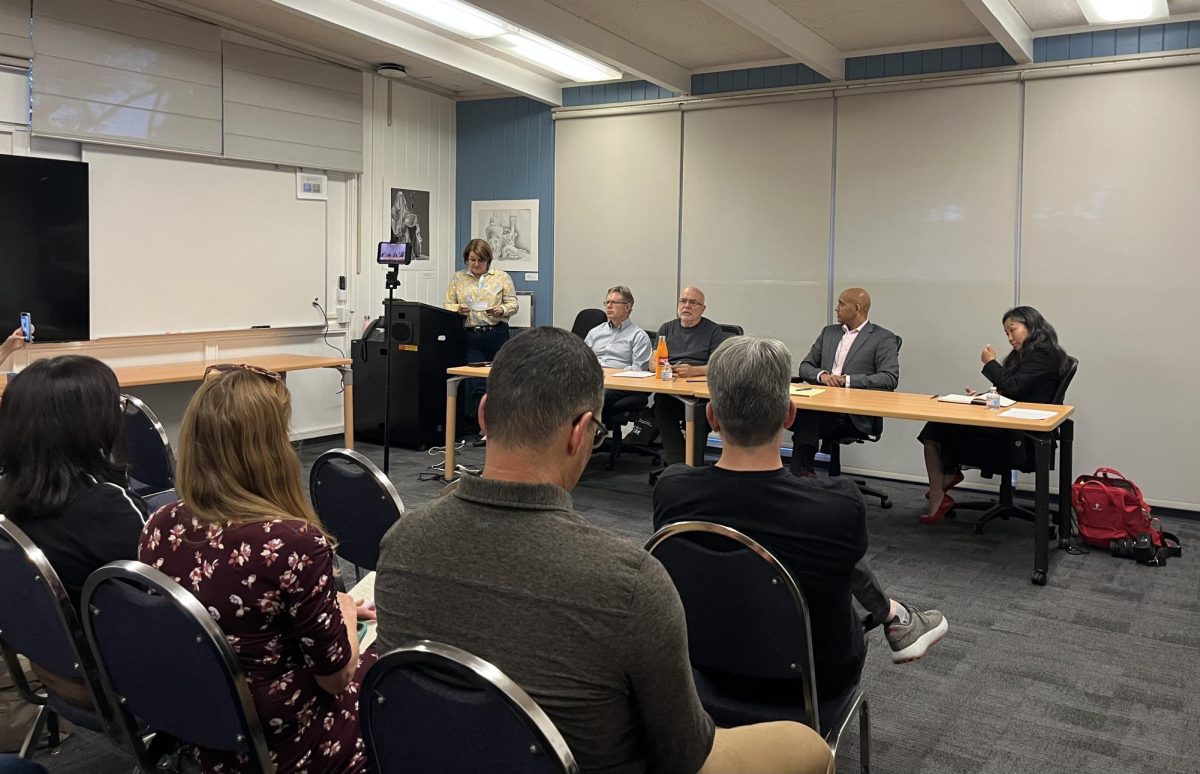
Community leaders and residents discussed the advantages and disadvantages of the proposal during a May 18 debate at the district office.
For many voters, a central point of contention for the district’s future is how it should manage its current surplus.
Linda Henigin, a longtime school volunteer and school board candidate, said the core issue is whether the district should rely on its reserves to fund upcoming expenses.
“It [the debate] is a conversation about spending down the reserves and whether we’re going to put ongoing expenses out of surplus and reserves that are not going to be refilled,” Henigin said. “We have no guarantee that that money will continue to come in.”
Speaking in opposition to Measure B, former school board members Todd Collins and Ken Dauber said PAUSD’s current reserve of over $100 million is more than enough to sustain the district without the surcharge.
“Far from being on the edge of layoffs, the district’s finances are in the best shape in living memory,” Collins said.
Dauber said the main way that Palo Altans fund public schools is through property taxes, which funds 75% of PAUSD’s budget, and that the district’s reserve far exceeds the state-recommended value.
“The parcel tax that we’re talking about is 5% … going down to 3% [of the budget],” Dauber said. “$100 million … is actually three times the amount that the state sets as the limit for reserves.”
Local Measure B supporter Chris Colahan said eliminating the tax would threaten the district’s workforce, as roughly 87% of the budget goes toward teacher compensation.
“If you cut [the] $15 million [annual parcel tax revenue] from the school district budget, the only way you can do that is either by not paying teachers as much or by having fewer teachers,” Colohan said.
Conversely, Collins said that the district’s regular property tax revenue has already been growing at a rate that matches the annual income from the parcel tax.
“In the last ten years, our property tax funding has doubled,” Collins said. “It’s up $150 million. That’s an extra $15 million a year over the last ten years. Our schools simply don’t need a $50 million surcharge [over the duration of the measure] on top of our already high property taxes.”
According to Collins, the district’s rising income has outpaced student enrollment because of a combination of global birth rate trends and the local high cost of living.
“Birth rates have fallen statewide, nationwide [and] globally,” Collins said. “This hits coastal California particularly hard, where our extraordinary cost of living makes it incredibly difficult for young families to buy or even rent a home. A surcharge is no longer required [because] we have 20% less students, but 8% more employees.”
Palo Alto Educators Association President Tom Culbertson said this increase in staffing reflects a broader shift in public education over the past decade.
“The mission of education has expanded immensely in the last 10 years,” Culbertson said. “The school district is trying to do a lot more stuff to serve students, and that requires people.”
Steve Godfrey, a Palo Alto resident and consultant who attended the debate, said he was considering these demographic changes when looking ahead.
“There have been some demographic shifts and there may be sufficient resources, in which case this particular measure may not be necessary,” Godfrey said. “I’m here to learn more about what both sides are saying and try to make an informed decision.”
Conversely, current board members Shounak Dharap and Rowena Chiu who are in favor of the measure, said at the debate that the tax is a necessary safeguard to maintain educational stability in the coming years.
“We don’t know what the economic uncertainty is going to look like next year, and in three years and in 10 years,” Dharap said. “The parcel tax is the only revenue stream that is not reliant on Sacramento or Washington.”
Chiu said the $100 million reserve is not as expansive as it appears and that it only covers three months of the district’s operating budget.
“A school district of $340 million is like the Titanic,” Chiu said. “It can’t be turned around quickly.”
Culbertson said the union fully supports the measure, and that predictable budgets are especially important amid recent leadership and board transitions.
“This parcel tax would certainly help keep the budgeting of the district stable and predictable,” Culbertson said. “If we don’t pass this parcel tax, it’s a bit of a risk for the community and it’s a leap into the unknown.”
Culbertson said passing the measure would also provide district management with financial comfort during ongoing contract negotiations as local housing costs outpace inflation.
“We’re craving stability right now because so much has changed this year,” Culbertson said. “This would be a great signal from the community that they care about education in this community.”
Palo Alto High School board representative Dylan Chen said he believes students should support the measure.
“District leadership changes plus salary negotiations that haven’t ended does provide some uncertainty,” Chen said. “The economic state of our nation’s inflation and economic policy are all quite volatile. I want to eliminate the risk of student services being in any possibility of uncertainty, [so] I am in favor of this measure.”
Board member Shana Segal said the public evaluation of the measure is a valuable exercise for the community.
“It’s important to hear both sides and to be informed on both sides, and then come away with your own opinion,” Segal said.