When you think of the object you use the most, what comes to mind? Your phone. For students throughout California, this may be changing soon.
Across the world, many students don’t see their phones from the first bell to the last. At Palo Alto High School, the wait is shorter — though if a new California Assembly Bill is passed, all public TK-12 schools of California will be required to implement “bell-to-bell” smartphone bans.
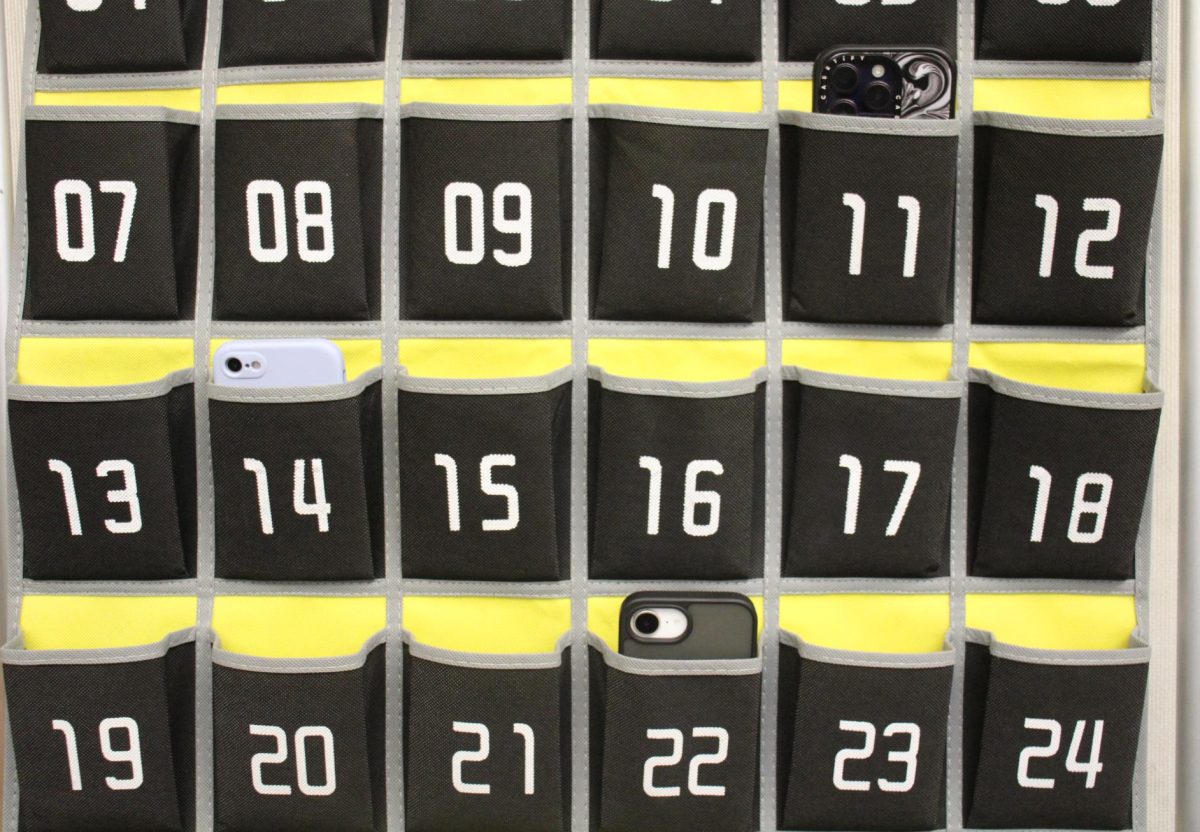
Paly’s current phone ban requires students to put their phones in designated spaces — assigned by the teacher — at the beginning of each class period. Previously, students were allowed to keep their phones with them during class as long as they didn’t become a distraction. Prior to the ban, students often played games or scrolled through social media during lessons and had fewer human connections.
In a recent community update, Paly “enhanced” its Focus-First Campus and Classroom Cell Phone Policy, with technology like glasses with recording or Artificial Intelligence software, wireless earbuds, iPhone mirroring and iMessages being banned during instructional periods.
Many states in the U.S., as well as countries like France and China, have implemented a “bell-to-bell” phone ban where students cannot use their phones from the first bell to the last. If the Legislature approves Assembly Bill 1644, this same rule would be put in place for all public schools in California.
During an October school board meeting, PAUSD delayed a decision on a district-wide “bell-to-bell” cell phone ban until 2028. However, if AB 1644 is passed, the district will join many others in a “bell-to-bell” phone ban.
According to Assistant Principal Michael Stieren, PAUSD adopted a more flexible phone policy compared to stricter approaches used by other districts.
“Palo Alto took a less restrictive approach than many other school districts,” Stieren said. “Adrian Wilcox High School chose a “bell-to-bell” [ban] with Yondr pouches [magnetic phone locking pouches].”
Stieren said he has changed his mind on the need for a “bell-to-bell” ban seeing how quickly students adjusted to this new rule.
“It’s [an in class phone ban] accomplishing what it needs to and I think my own thinking around this has shifted,” Stieren said. “I thought a “bell-to-bell” ban is the better way to do it, because it just would make it easier more black and white. But the reality is the kids have adapted to it pretty well. Ultimately, it has … been a pretty smooth transition.”
Stieren said he and the district hope limiting phone use during class will encourage students to focus more on learning and participation.
“They [the PAUSD district] wanted to create an environment where you’re unplugging for just for a period of time, and then if you need to plug back in you can,” Stieren said. “If the purpose of going into class is to spend time learning from a teacher on a particular curriculum and engaging with your peers on a particular activity, not having access to this [cell phones] inherently will increase participation.”
Stieren said most parents reacted positively once they understood the policy’s purpose and safety measures.
“I would say parents have been fine with it as long as they understand it,” Stieren said. “Once parents understand sort of what the law is requiring of schools, and then the ways in which we can still get you access to your child at a moment’s notice, they’re fine with it.”
Junior Maria Uribe said that while she doesn’t like the ban, she thinks it achieved its purpose of keeping students off their phones and more attentive in class.
“I definitely have seen people use their phone less, even if they don’t put it away, because they’re scared of their teacher seeing them,” Uribe said. “A lot of people don’t think it’s worth it to sneak it — they’d rather just put it away or have it in their bag if they don’t want to put it in the holder. … I hope the school doesn’t go further than what’s happening with the system right now because the current system is working pretty well.”
Math teacher Gabrielle Juan said she has seen improvement in the connection between students since the implementation of the policy.
“[I] definitely see more students talking to each other,” Juan said. “Sometimes we’ll have students play games on the computer instead … I think it’s fine to have some breaks in between the lessons as long as we’re not overly addicted to it. There’s definitely been more peer-to-peer interaction, whether it’s just talking to each other or maybe playing games online. It’s shifted from phone to computer.”
Sophomore Niccolo Resmini said he feels the ban does not solve the problem of students not focusing on their work during class time.
“Many people just go on their computers instead, but they do talk more,” Resmini said. “If people aren’t going to do their work, they’re not gonna do their work. So I don’t think banning phones really does anything.”
Juan said the policy has helped decrease the number of students using their phones in class.
“Most students have been really great with it [the in-class phone ban],” Juan said. “Once in a while, we’ll get students who try not to put it in there. I would say it’s not ideal, but for the most part, I appreciate the cooperation of most students because I know it’s not easy.”
However, Juan said enforcing the policy can be challenging while managing other classroom demands, sometimes requiring her to check the phone caddy and call out students who haven’t put their phones away.
“I personally find it slightly difficult for teachers to monitor,” Juan said. “In a classroom of 30 students, with students coming in at different times, and I’m teaching and monitoring attendance, it’s a lot going on for teachers. I personally would prefer not to have to do that. … It definitely should be considered; how do we make this easier for teachers?”
Echoing similar concerns, history teacher Jaclyn Edwards said the system is not entirely effective, with some students continuing to use their phones in more discreet ways or using computers instead.
“I don’t see it as a foolproof system because there’s always a way where people are still going to end up doing something they shouldn’t be doing,” Edwards said. “We have to continue to navigate around that. It [the in-class phone ban] has deterred people from doing the obvious.
According to junior Dalia Saal, while the policy has been successful overall, it hasn’t completely solved the issue.
“It [the phone ban] has been beneficial in getting the phones out of the hands of students,” Saal said. “But people are a lot more comfortable going to various websites like games and social media on their computer, and they’re a little bit more normalized to doing that [now]. … The majority of kids are relatively diligent, so I’d say it has made a difference, but it definitely hasn’t eliminated all of kids’ social media usage at times.”
Saal said that while the policy has been effective overall, she has noticed potential dangers with phones being stored away during evacuations or safety drills.
“Every time we’ve had a fire drill or alarm, every kid runs to the phone caddy and scrambles to get their phones,” Saal said. “I feel like that is a real safety hazard. It could be solved if there were a teacher who would always pick up [our] phones when we leave for an emergency.”
Uribe said she has noticed differences in how strictly the policy is enforced across classrooms.
“Some teachers are pretty strict on putting my phone away,” Uribe said. “Some will call you out if you don’t put it [your phone] in the slots, but some are more lenient. … I do notice that the majority of my teachers do look at who put their phone in the holder and who didn’t, and I’ve noticed some substitutes even use it to take attendance.”