Editors’ Note: Resources for any person who is feeling depressed, troubled or suicidal are listed at the bottom of this article.
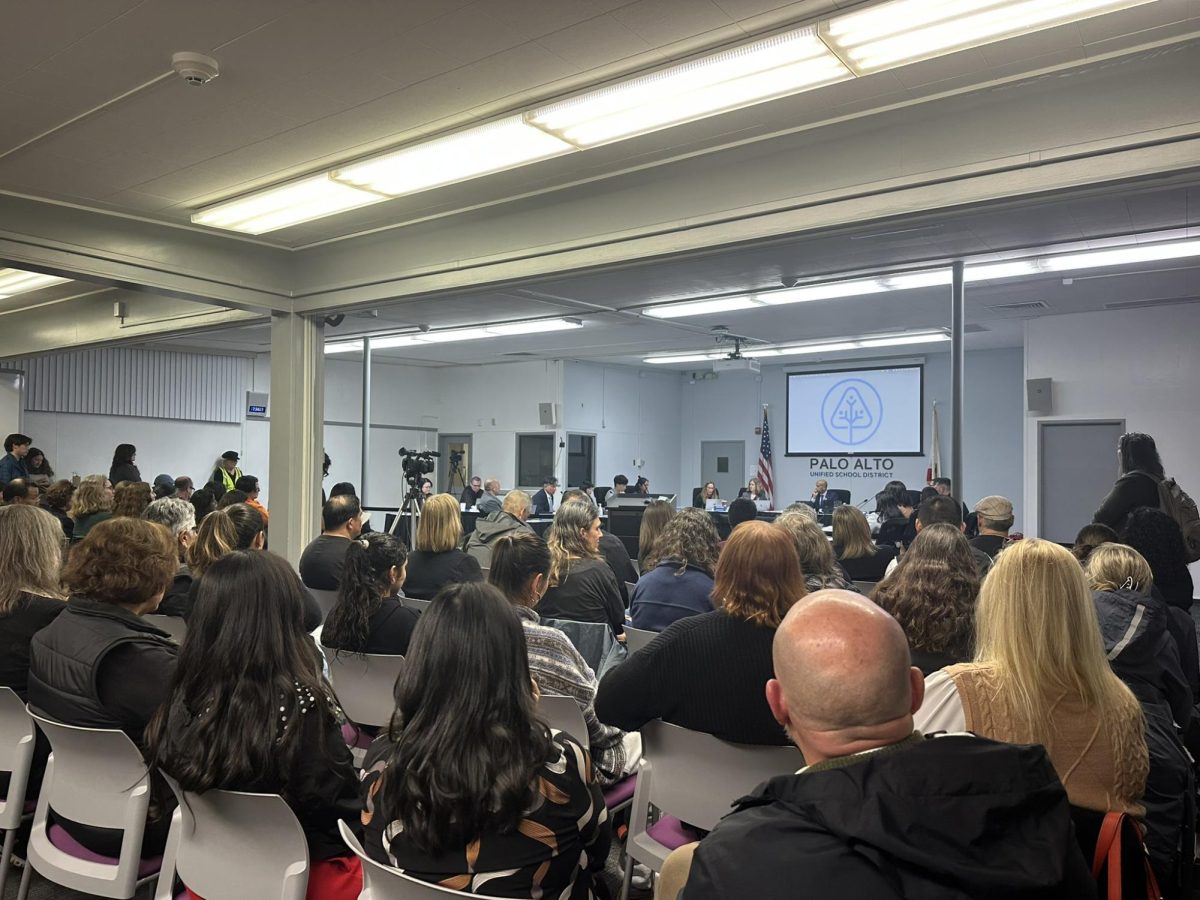
Students and staff at the Board of Education meeting Tuesday night spoke out to ask for more communication and support from the district to help improve student wellness.
The meeting comes amid multiple student suicides at Palo Alto rail crossings over the past year, incidents that have prompted calls for immediate safety measures.
The meeting also addressed budgeting and union contracting issues, but much of the discussion focused on student safety. There was broad agreement when Superintendent Don Austin said a temporary closure of the Churchill Avenue rail crossing is needed in order to prevent further tragedies.
“I’ve made a statement recently that I think Churchill Avenue should be closed,” Austin said. “For as many people who said that they would do anything to prevent another tragedy, I got a lot of people who wrote back about how inconvenient it will be for their travel. I’m fully aware of that. A temporary closure is exactly what we need right now. I, like everybody in this room, am terrified of hearing that we have another one [student death].”
Junior Olivia Carlstrom said that while she is grateful for PAUSD resources like the Wellness Center, she believes there is more the district can do to improve student use of these resources.
“Recently, I attended a student mental health meeting at Paly, and I spoke about adding an option of a wellness sign-out option,” Carlstrom said. “Many people don’t want to have to go up to a teacher in the middle of class with your classmates listening to you at a point when you are very vulnerable to ask to go [to the Wellness Center] for support.”
Board member Allison Kamhi said recent events underscore the need for the district to allocate funding toward immediate safety measures.
“The first [comment] is making sure that in light of the tragic loss of Summer [Mehta] last week, that our budget reflects our commitment to … keeping kids safe,” Kamhi said. “To me, that means making sure the budget allows for crossing guards or security guards. I am in support of allocating funds to work with the city on implementing crossing guards or security guards ASAP.”
Student Board Representative and Gunn High School senior Angelise Chang said she wanted to highlight a commonly repeated phrase at Gunn about using the Wellness Center when upset.
“Like my fellow board reps, my report will be different than usual,” Chang said. “I want to highlight something our wellness commissioner, Melody Song, brought up. It’s a specific phrase that’s almost cliché at Gunn, which is ‘Please use the Wellness Center if you’re feeling upset.’”
Chang said the well-intentioned phrase oversimplifies students’ experiences and reflects poor communication between administrators and students.
“When a student dies, we often receive the same vague and impersonal response: an email that avoids the issue head-on and passively directs students to mental health resources,” Chang said. “We feel like the district doesn’t care. If privacy is a concern, [decisions] are not explained, and if reforms are being made, we certainly don’t hear about it. Inadequate communication alienates administrators, when we should all be working on the same goal.”
Chang said framing mental health resources as temporary rather than ongoing and preventative creates barriers for students who need help.
“The phrase ‘If you’re feeling upset’ implies that mental health is a temporary issue,” Chang said. “A recent Oracle survey found that the majority of Gunn students know where to find resources but are not comfortable using them. Places like the Wellness Center are viewed as corrective, not preventative, which discourages students from using them. Obviously, transforming how we fundamentally view this issue is easier said than done.
Chemistry and AP Research teacher Samuel Howles-Banerji said that the proposed budget cuts would weaken the district’s and teachers’ ability to directly support student wellness, particularly through classroom relationships and day-to-day interactions.
“A strong district requires the best teachers and the best support staff for those teachers and students,” Howles-Banerji said. “We can’t afford it, and we have to make difficult cuts. Those cuts should not come from the foundations that support students. We [the teachers] are the ones who are asked to write letters of recommendation for colleges and summer programs. We are the ones sitting with students while they mourn the death of their friends. We are the ones charged with noticing the subtle changes in mood that might indicate something is wrong to refer those students to mental health services. You don’t support students by telling teachers that they are worthless. You support students by making teachers feel valued and allowing teachers to spend more time with their students.”
Chemistry teacher and PAUSD alum Margaret Deng said that what she believed was her dream job has turned into something of a nightmare.
“I’m disheartened to see that in the time since I graduated from Gunn in 2012, the response to tragedy has, in fact, regressed,” Deng said. “You say that there will be action, but you’ve had a year to do something, anything. Inaction speaks volumes. What will you do to ensure that no one else will have to live with the same trauma I’ve carried since I was 14 years old? Will you build up and support your teachers and students and act like the leaders we elected you to be? Respond with compassion and empathy and willingness to listen, or will you continue to sit in stoic silence, effectively watching us crumble? Talk to us directly. Visit our campus. Get to know us.”
If you or a friend are in need of immediate support, use the resources listed below:
Call 911 or 988 Lifeline
Crisis Text Line: Text ‘HOME’ or ‘HOLA’ to 741741
National Suicide Prevention Lifeline: Call or Text 988
Trevor Lifeline LGBTQ+ Crisis Support: 1-866-488-7386
Bill Wilson Youth Hotline (24-hour Suicide & Crisis Line): 408-850-6125