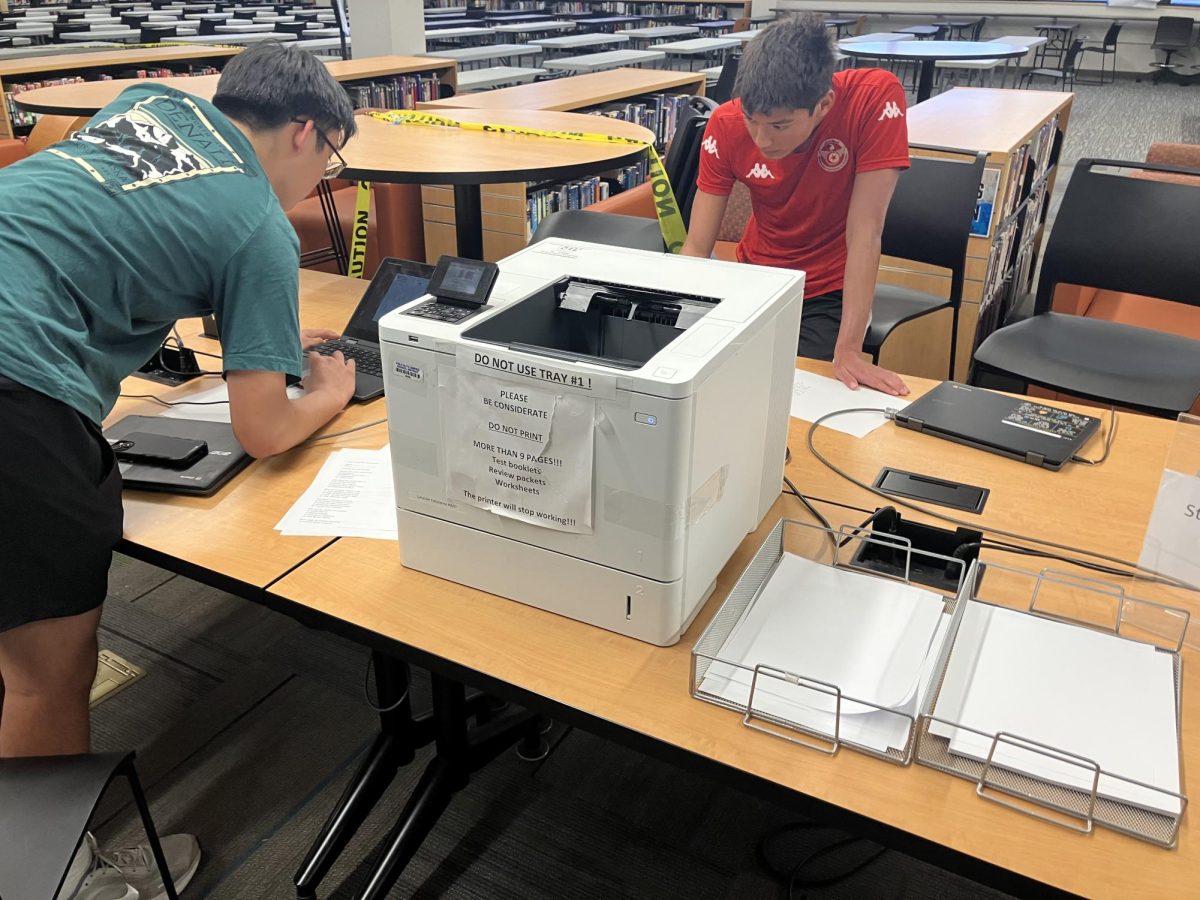
It’s a tale of two schools. Paper and digital. Old and new. The past and the future? Not necessarily. As digital technology falls short, some teachers at Palo Alto High School have returned to paper, and the effects on the budget are measurable.
For years, Paly has seemed to follow the national trend in paper use.
Data from Statista show enormous growth in paper use in the late 1900s, a peak in the early 2000s and then a decline due to the explosive growth of the Internet.
But since COVID-19 ended, while paper use has dropped nationally, Paly has seen an uptick in paper consumption, at about half a ton more paper annually, according to assistant principal Jerry Berkson.
How can it be that at the dawn of artificial intelligence, in STEM-heavy Silicon Valley, a top school is backsliding into more paper use, not less?
Teachers have many explanations, from studies to qualitative observations, but they all boil down to one thing: paper is better for learning.
Hilary McDaniel, a Paly child development teacher, said that recent studies have changed her mind about technology in the classroom, causing her to have her students use more paper.
“[A study] prompted my teaching partner and [me] … to remove all of our online reading from our course and to return our students to writing with pencils and paper,” McDaniel said. “I think the research has been growing and it is now pretty clear that our brains are not designed to read that way.”
According to “We Gave Students Laptops and Took Away Their Brains,” by neuroscientist Jared Cooney Horvath, reading on a screen is less effective for learning, as the brain’s memory center mentally maps the world.
“When we read from paper, each word occupies a fixed, physical location,” Horvath wrote. “If you’re reading a printout of this piece right now, this sentence exists right here — and this spatial position becomes part of the memory you’re forming. … Digital text has no such stability. … With no fixed location for ideas to attach to, the spatial scaffold that supports memory collapses.”
According to David Cohen, a Paly English teacher since 2002, high paper use like the study recommends was the case at Paly before digital tools arrived.
“Students had to print every essay that they wrote, every assessment, every quiz or test was done on paper,” Cohen said.
Sarah Bartlett, an English teacher since 1998, said that students did noticeably better when there was less technology.
“Their attention spans were better,” Bartlett said. “They learned better. They worked harder. They worked slower. It’s slow to have to hand write your thesis statement. It’s painful now, but it didn’t used to be. It’s only painful because you’re used to a 10 second TikTok video.”
Although paper use is on the rise at Paly, technology is still pervasive in schools and, according to Bartlett, can be seductive.
“We get excited about the new technology or the new thing and we don’t think about what the potential downsides might be,” Bartlett said. “The Apple TV was a game changer [in education]. The doc cam was a game changer. But I don’t think putting a Chromebook in the hands of every kid was a positive game changer.”
McDaniels agreed with Bartlett, and said that when compared with paper, new technology can be dangerously easy to use.
“It is so convenient for me [to say] ‘Go read chapter 10’ and it’s available to you on Schoology,” McDaniel said. “[Compared to] collecting all their work, filing it, … keeping track of it. [But] when it’s turned in online, I don’t lose a paper.”
According to an email from McDaniel to The Paly Voice, advanced technology is useful, but must be used carefully.
“I also don’t think that high school students or maybe even middle school students shouldn’t use AI tools, but it has to be monitored and scaffolded very thoughtfully and AI tools have to be developed ethically,” McDaniel stated.
According to Cohen, people are beginning a shift back to non-digital tools, as a reaction to today’s extremely digital environment.
“Some people are feeling like we’ve gone too digital and it might be better to get off our devices a little bit more frequently,” Cohen said. “There might be a little bit of a pendulum swing back.”
Additional reporting by Navya Narayanan.