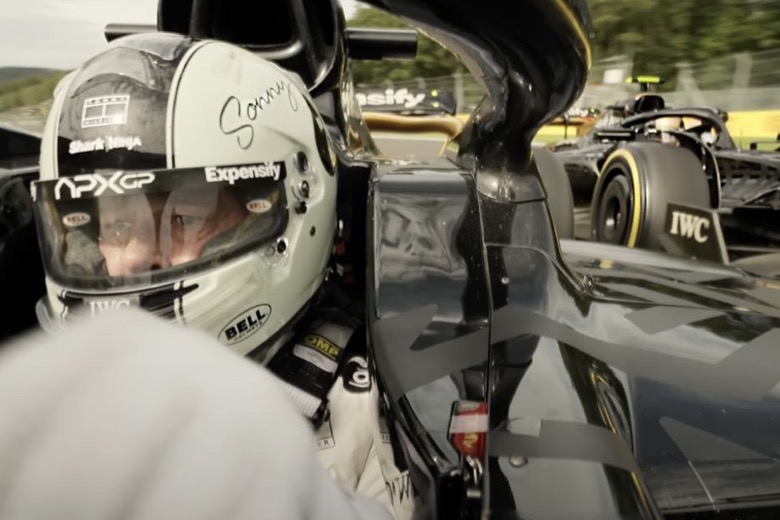
“If the last thing I do is drive that car, I’ll take that life, man — a thousand times.”
Joseph Kosinski’s “F1: The Movie,” an American sports drama film released on June 27, has received four Academy Awards nominations this year: Best Picture, Visual Effects, Sound and Film Editing. It follows Sonny Hayes (Brad Pitt), a race car driver whose career takes an unexpected turn when he is asked by an old friend, Rubén Cervantes (Javier Bardem), to join his crumbling team as an F1 driver alongside Joshua Pearce “JP” (Damson Idris).
Sonny reluctantly returns to the world of F1 racing after Rubén tells him he could lose ownership of the team if his drivers fail to win at least one race. Desperate for help, Rubén turns to Sonny, believing that despite retiring from F1 30 years earlier, his experience could still make a difference. Once Sonny joins the team, tension quickly develops between him and his teammate JP, who sees Sonny as too old to compete and as someone blocking his path to success. As their season continues, the film’s focus shifts to the pressure of races, between the media attention and the internal conflicts within the team. Sonny’s techniques and chaotic racing style aren’t well-received by his teammates and engineers, while JP struggles to balance his ambition with the reality of the pressure placed on him to deliver a win.
Through a series of difficult races and setbacks, the two drivers slowly begin to recognize each other’s strengths and weaknesses and start working together to move up the rankings. By the final race of the season, the audience is left on the edge of their seats, while Sonny and JP cooperate more than ever before, leading to a dramatic turnaround with Sonny winning the Monaco Grand Prix.
While the plot contains a lot of Hollywood clichés — an unrealistic comeback by a veteran driver, exaggerated action and a sentimental but unlikely final race win — when combined with the racing scenes and sound effects, it is elevated into something that will draw new fans in. Small details are scattered throughout the movie, whether it’s flashbacks to Sonny’s past life, bets placed between characters or hints of a romantic relationship, creating a more engaging story.
According to junior Caroline Lee, the clichés make the movie too predictable, taking away from the suspense that comes with watching a new film.
“I didn’t particularly like how the movie plot was so typical,” Lee said. “I could tell what the ending was going to be, and I prefer more excitement.”
A highlight of the film, the soundtrack comprises songs by artists from all over the globe — ranging from Don Toliver to ROSÉ to Tate McRae — and Hans Zimmer’s orchestral score. The music accentuates and complementes the fast-paced nature of the sport as well as its international reach, upgrading the viewing experience.
According to Lee, both the music and the scenes are notable aspects of the movie, enhancing the typical plotline.
“My favorite part was the artistry; they were very detailed with how they shot the movie, and they executed the shots very well,” Lee said. “I also really liked the soundtrack, especially the orchestra part that Hans Zimmer directed.”
While the film features impressive racing sequences and visually striking shots of the cars, it felt more like an advertisement for Formula 1 than a fully developed story. The repeated focus on racing scenes becomes repetitive and makes parts of the storyline easier to forget. Nearing the end of the film, it begins to feel longer than necessary. Certain moments, including the final scene in Baja California where Sonny heads off to compete in a rough spit-and-sawdust race to chase the raw thrill of racing he hadn’t felt in years before the Grand Prix, seem somewhat unnecessary.
Sophomore Arnav Shah, a fan of F1, agreed with this sentiment, noting and said that some parts focused more on making the movie entertaining than on accuracy.
“One thing I didn’t like as much was that sometimes it felt kind of overdramatic or unrealistic,” Shah said. “I get that it’s a movie, so obviously they want to make it more entertaining, but there were a few moments that felt a little too exaggerated.”
However, Shah said that the videography helped improve the realism of the scenes, immersing viewers in the movie.
“My favorite parts of the movie were the racing scenes because they felt very intense and exciting,” Shah said. “I also liked how the movie showed the intensity of Formula 1 and how much teamwork goes into it. It made everything feel really high stakes, which kept it fun throughout the movie.”
Though the movie did show the vigor of F1, at times it seemed as though it was a two-hour-long ad for the sport. Both Sonny and JP don’t experience monumental changes besides learning about the power of friendship and teamwork.
As Sonny returns to the high-stakes world of F1, his maturity clashes with JP’s desire to prove himself, setting the stage for a stressful rivalry between a driver whose career never reached its full potential and a rising young star. While the conventional scenarios don’t merit its best picture nomination, the movie is a strong contender in other categories with its impressive shooting and sound design.
“F1”
2 hours, 35 minutes
Rated PG-13
Directed by Joseph Kosinski
Starring Brad Pitt, Damson Idris and Javier Bardem