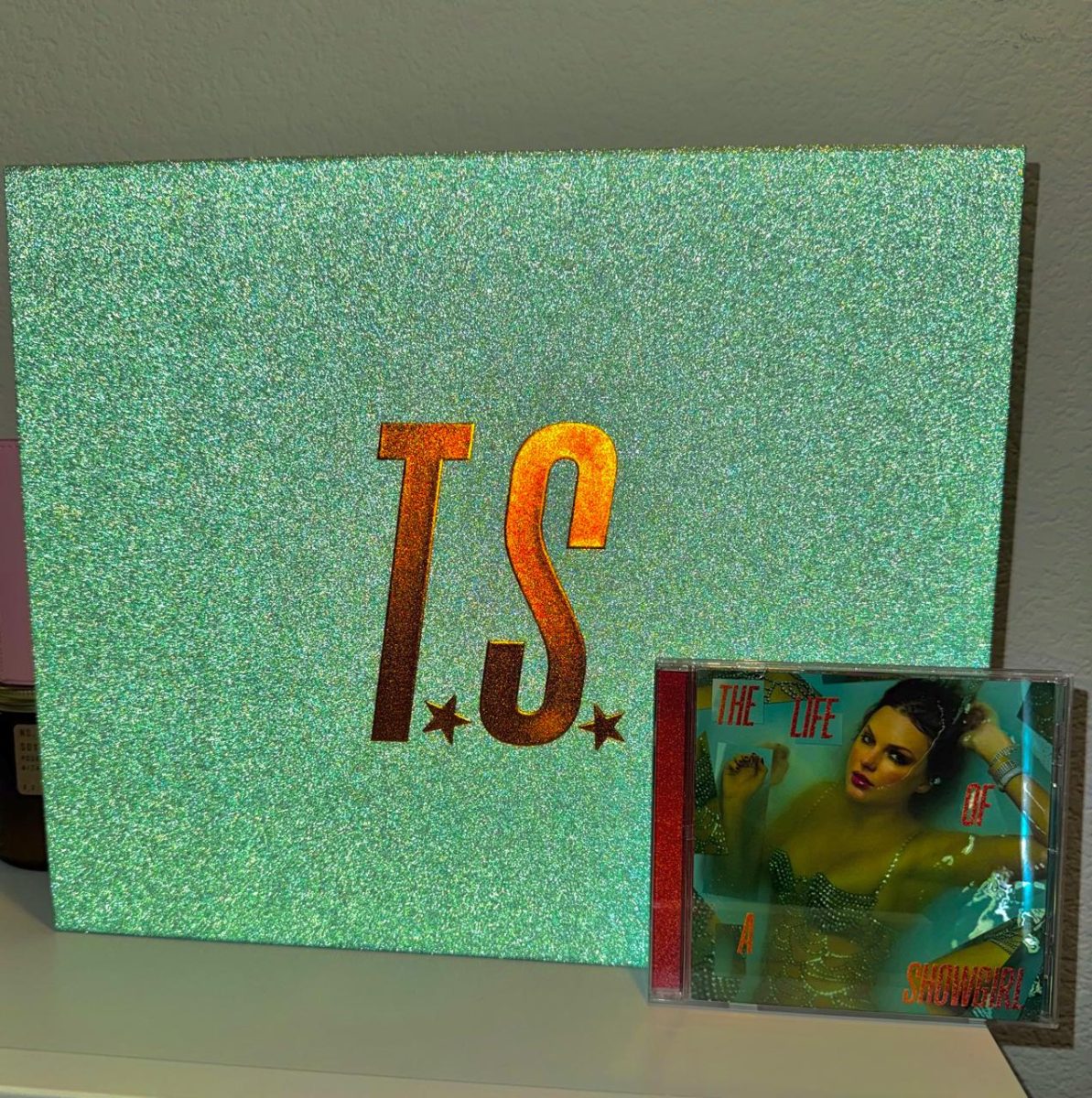
After promoting kaleidoscope-inspired previews of glamorous and bedazzled performers, Taylor Swift released her highly anticipated 12th studio album, “The Life of a Showgirl,” on Friday, Oct. 3. The 14-time Grammy winner announced that the album would feature similar lyricism to her 2020 album “Folklore,” with the pop vibe of her album “1989.” However, to many fans such as ourselves, much of the album lacked novelty and felt repetitive, lacking the Broadway-inspired glamour that we expected.
Palo Alto High School junior Fiona O’Neill, for instance, hoped that the album would feature more extravagant tunes.
“I thought it [the album] would have more influence from 50s Broadway music because that’s what the photoshoots insinuated when Taylor promoted the album,” O’Neill said. “It seemed like she was trying to appeal to too large an audience.”
Swift’s opening track, “Fate of Ophelia,” pairs a catchy tune and upbeat tempo with a predictable feel, reminiscent of her last album, “The Tortured Poets Department.” Inspired by Shakespeare’s tragedy “Hamlet,” Swift narrates her escape from the fate of Ophelia, Hamlet’s wife-to-be. Following her father’s death, Ophelia puts the needs of the men in her life before her own, eventually drowning in grief. In Swift’s version, she rewrites Ophelia’s destiny.
“You dug me out of my grave and / saved my heart from the fate of / Ophelia,” Swift writes.
“Ophelia drowned because Hamlet just messed with her head so much that she went crazy, and she couldn’t take it anymore. … Basically, [the song says that] you are the reason why I didn’t end up like this tragic, poetic heroine,” Swift says in “The Official Release Party of a Showgirl” movie.
This isn’t the first time Swift has drawn inspiration from Shakespeare’s plots. Her popular love song “Love Story” gives “Romeo and Juliet” a happy ending, sending a powerful message: Life can be turned around, unlike the tragic stories of Juliet or Ophelia. Although the lyricism in the verses is strong, the song feels rhythmically and musically flat.
While Paly junior Tessa Berney enjoyed several songs, she agrees the album does not live up to expectations.
“The fate of Ophelia is my favorite song from the album,” Berney said. “I agree with the masses that for this album specifically, it seems like the writing was rushed, making the quality of the lyrics much lower than her usual albums.”
Following Ophelia’s story, Swift jumps into the life of the late Hollywood star Elizabeth Taylor. The actress’s love life was heavily publicized, putting her under the spotlight during her eight marriages. Swift compares Taylor’s complicated romances with her own, as she too has faced scrutiny for her relationships.
“In the papers, on the screen, and in their minds,” Swift sings, describing how privacy is impossible with fame.
The song’s opening feels dull, with verses lacking rhythmic or vocal creativity. However, the refrain recaptures Swift’s trademark angsty pop sound.
The album’s third track, “Opalite,” is our favorite on the album. The nostalgic guitar riff and classic Taylor harmonies in the chorus could belong on her 2019 album “Lover.” While the song carries her signature theme — meeting the love of her life who brightens her world — “Opalite” feels fresh and catchy, comparable to her well-loved song “Paper Rings.”
Swift’s new song “Ruin The Friendship” also embodies this classic Taylor feeling, as she sings about risking a friendship to pursue love through clever lyricism.
The album’s 11th track, “Honey,” sounds like an attempt at the same vibe, but feels unnecessary. Although a lively drum beat plays while Swift sings about genuine love, it ends up feeling generic and repetitive.
Besides love songs, “The Life of a Showgirl” includes several diss tracks. Without paying close attention to the lyrics of “Actually Romantic,” one mistakenly interprets them as describing a lovesick boy chasing after Swift. However, many fans speculate that the song could be about artist Charli XCX, as Swift seemingly calls her out for writing her “a song saying it makes you [Charli] sick to see my [Swift’s] face.” This is purely speculation — Swift has not confirmed any feud or interview comment related to the song — but the lyrics suggest frustration with someone who publicly criticized her.
Many fans, like Berney, saw similarities between the album and other popular songs, such as “Cool” by the Jonas Brothers, which closely resembles the title track.
“As a Pixies fan, I was shocked when I heard Actually Romantic because the intro sounds exactly the same as Where Is My Mind,” Berney said.
Another diss track, “Father Figure,” feels unoriginal, comparing a mentor-apprentice relationship to a toxic bond. The song shares melodies with the late British musician George Michael’s hit of the same name. While Swift hasn’t revealed who inspired the song, fans online have guessed it might reference Olivia Rodrigo or Scooter Braun, both of whom have had public disagreements with Swift. Still, the lack of clarity and fairly basic lyrics make it feel unfinished.
Another formulaic track, “Eldest Daughter,” sounds like Swift copied and pasted material from an angsty middle-schooler’s Notes app.
“Every joke’s just trolling and memes / Sad as it seems, apathy is hot / Everybody’s cutthroat in the comments / Every single hot take is cold as ice,” Swift sings. “But I’m not a bad bitch / And this isn’t savage.”
The song’s basic chord structure and cringeworthy lyrics reference dying TikTok trends. Most of the lyricism is shallow and unable to compare with her older songs, similar to track 12, “CANCELLED!”
“Did you girl-boss too close to the sun?” Swift sings.
Although her verses sometimes feel too millennial, referencing old Gen Z slang and jumping unnaturally from low to high notes, the catchy chorus feels like it could belong on “Reputation,” bringing back Swift’s classic edgy pop vibe.
The album’s eighth track, “Wi$h Li$t,” also feels like Swift is trying to stay relevant.
“They want those bright lights and Balenci’ shades / And a fat ass with a baby face,” she writes.
The song feels like an attempt at an Ariana Grande “7 Rings”-style parody, with a hip-hop beat, rap-like sections, and lyrics about materialism and fame.
The ninth track, “Wood,” is immediately catchy, partly because Swift borrows its intro from “I Want You Back” by the Jackson 5. The song creatively incorporates superstitions — black cats, crossing fingers, wishing on stars — and even adds a knocking sound during the chorus line, “I ain’t got to knock on wood.” However, the song’s sensual metaphors, such as “redwood tree” and “magic wand,” are a noticeable shift for Swift, reflecting her artistic growth and confidence. Some fans might see it as a mature new phase, while others could view it as a departure from her earlier innocence.
“Redwood tree / It ain’t hard to see / His love was the key / That opened my thighs,” she sings.
The title track, “The Life of a Showgirl (feat. Sabrina Carpenter),” is placed earlier in the album and serves as one of its strongest moments. Through a well-blended duet, Swift and Carpenter tell both sides of a showgirl’s story — the glamor and the exploitation. The finale feels like a pop twist on a New York Rockette’s performance, closing with the artists thanking the audience for “watching the show.”
“The Life of a Showgirl” offers an uneven mix of storytelling and pop experimentation. While tracks like “Opalite” and the title song showcase Swift’s brilliance, others feel rushed or uninspired. It’s not her strongest album, but it does show her willingness to evolve, take risks, and blur the line between pop spectacle and personal storytelling — whether the crowd applauds or not.