“And thus the heart will break yet brokenly live on.”
—Lord Byron, Childe Harold’s Pilgrimage
As a Royal Danish Navy ship drifts through the North Pole’s frozen Arctic Ocean, the crew aboard the Horizon discovers a gravely injured Victor Frankenstein (Oscar Isaac) stranded among the ice. Missing a leg and clinging for life, Victor recounts the story that led him there: a creation that would ultimately haunt him for the rest of his life. This chilling opening scene sets the stage for “Frankenstein,” a haunting reinterpretation of Mary Shelley’s 1818 gothic novel.
Directed by Guillermo del Toro, the adaptation premiered at the 82nd Venice International Film Festival on Aug. 30 and had a limited theatrical release in the United States from Oct. 17. The film earned nine nominations for the 98th Academy Awards, most notably for Best Picture and Best Supporting Actor for Jacob Elordi’s portrayal of the Creature.
This story is split into parts, beginning with Victor’s side of the story. Although the novel is set in late-18th-century Germany and Switzerland, this film is set later, during the Victorian era in England.
After the death of his mother during the birth of his younger brother William, Victor grows resentful toward his father and becomes consumed with the idea of conquering death. A brilliant but arrogant surgeon, he is expelled from the Royal College of Surgeons of Edinburgh after conducting forbidden experiments on reanimated corpses. Refusing to abandon his work, Victor accepts funding from wealthy arms dealer Henrich Harlander (Christoph Waltz), who provides him with a secluded tower to continue his research.
Driven by ambition and mounting pressure, Victor assembles a body using parts from soldiers and criminals killed in the Crimean War. His goal? To defeat death itself. When a storm finally strikes the tower and the Creature awakens, Victor realizes that his greatest scientific triumph may also be his greatest mistake.
The Creature begins as an innocent being capable only of speaking Victor’s name. However, Victor’s growing fear of his own creation leads him to treat the Creature with cruelty and neglect.
Palo Alto High School English teacher Keith Tocci said that he enjoyed both Shelley’s original novel and the film adaptation.
“Each presents the story through a different medium and reflects the different contexts in which they were created — and I enjoyed both on their own merits,” Tocci said.
The film’s narrative shifts dramatically when the Creature recounts his own story. Living secretly on a farm, he quietly helps a struggling family while observing humanity from afar. Through a friendship with the family’s blind patriarch, the Creature learns to read, speak and understand the world around him. These moments reveal the Creature as any other being searching for belonging.
Similarly, Tocci said that del Toro reshapes Mary Shelley’s original narrative by emphasizing the emotional relationship between Victor and his creation.
“Del Toro’s adaptation treats the novel as myths to play with,” Tocci said. “Frankenstein’s relationships with his parents are developed in a way that establishes clear motivations for him to create the Creature, and the Creature’s arc is also more focused on this parent/child dynamic so that the concluding resolution ties more threads together in a satisfying way. As with most film adaptations of novels, they’ve cut and reduced, but what’s left is something more focused and clear — which also means losing some of the rich ambiguity that comes with novels and life.”
Remaining aligned with the setting of the time period, the soundtrack comprises orchestral and classical pieces by composers such as Johann Sebastian Bach, Wolfgang Amadeus Mozart and Henry Purcell. Composed by Alexandre Desplat, the score blends sweeping orchestral arrangements with delicate violin passages to reflect the Creature’s emotional journey.
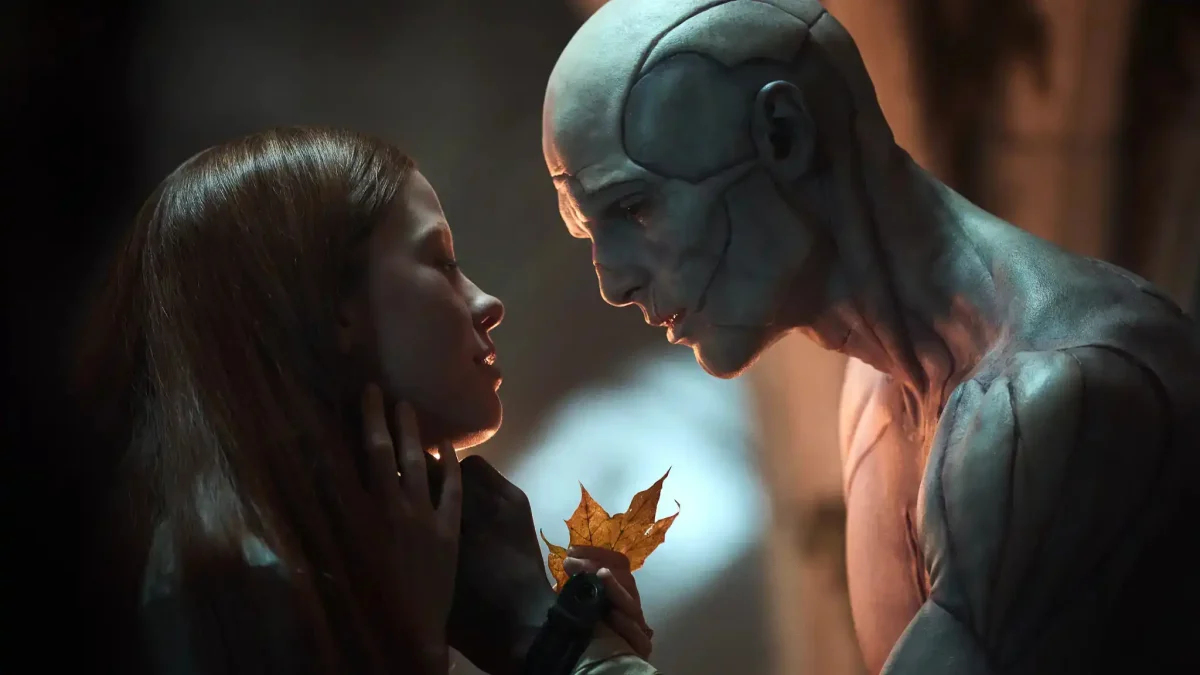
We especially applaud Elordi’s portrayal of the Creature. Even with his major lack of dialogue, he is still able to express the Creature’s emotions through subtle physical movements and facial expressions, allowing the audience to understand his loneliness and longing for connection without the need for many words. This is shown when the Creature gently offers a leaf to Elizabeth (Mia Goth), a small yet powerful gesture that reflects the Creature’s innocent attempt to show kindness and connect with another being.
The film had stunning makeup design, especially for the Creature, whose appearance was both haunting and strangely beautiful. Instead of portraying him as a purely grotesque monster, the filmmakers designed him as a tragic, almost statue-like figure assembled from soldiers’ bodies, emphasizing both the violence of Victor’s creation and his underlying humanity. The look required extensive prosthetics, as Elordi wore 42 separate prosthetic pieces across his body, with makeup that took nearly 10 hours to apply each day, carefully arranged to resemble the stitched-together anatomy of a resurrected body.
The design avoided overly exaggerated scars or grotesque wounds, which could be to reflect Victor’s true intention to create the “perfect man” rather than a monstrous experiment. Instead, subtle seams, pale skin tones and carefully placed textures created a creature that feels both fragile and powerful, reinforcing the film’s central theme that the Creature is not innately monstrous.
Although the film runs two and a half hours, “Frankenstein” continuously engrossed us as each twist and turn in the story remained compelling. Even for viewers who have read the novel it was based on, it is still fascinating to see the film’s differences and interpretations of the classic story.
Like any film del Toro directs, “Frankenstein” is a visually stunning dark fantasy film, blending horror with fairy tales through whimsical and often melodramatic storytelling, making it a strong contender for Best Picture. From Isaac’s frenzied portrayal of Victor to Elordi’s empathetic performance as the Creature, del Toro’s creation invites the audience to immerse themselves in the haunting consequences of ambition and the complicated bond between creator and creation.
“Frankenstein”
2 hours, 30 minutes
Rated R for bloody violence and grisly images
Directed by Guillermo del Toro
Starring Oscar Isaac, Jacob Elordi, Mia Goth and Christoph Waltz