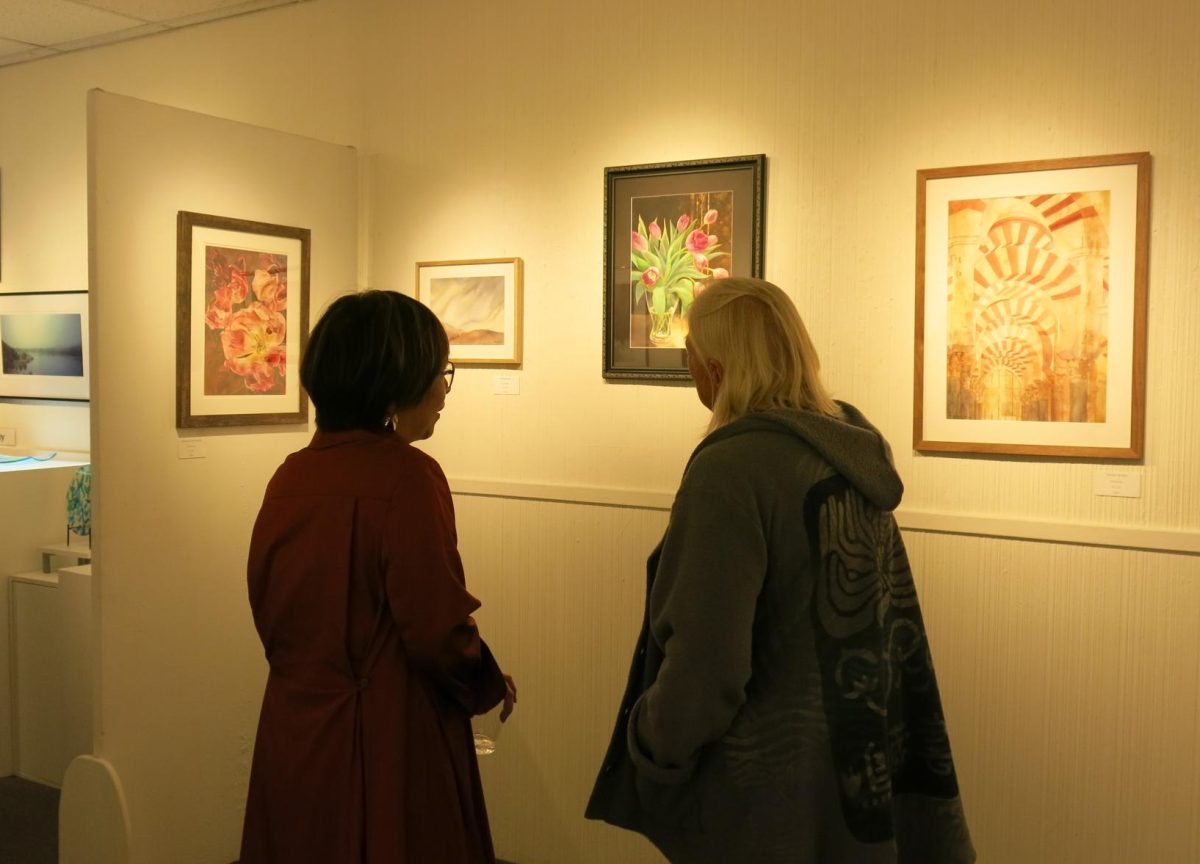
Watercolor artist Mami Weber’s new exhibition, “When Light Turns to Memory,” takes inspiration from her Japanese heritage and is on display until March 3 at Gallery 9 at 143 Main St. in Los Altos. The exhibit opened with a reception on Friday evening.
Weber was born and raised in Tokyo and has lived in California for over 30 years. She takes inspiration from both Western and Japanese art, including one painting of a pond. In this piece, Weber used a traditional Japanese water-marbling technique — where ash-based ink is floated on water — to make organic flowing shapes. She also used black Japanese sumi ink to paint lily pads and Western watercolor paints to add goldfish.
“When Light Turns to Memory” is Weber’s fourth exhibit since joining Gallery 9 in 2017. The gallery is run by artists who have the opportunity to present their work in an exhibit every two years. This exhibit showcases Weber’s unique style, blending detail-oriented realism with emotional storytelling.
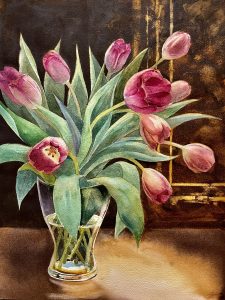
“I paint very realistically, but with a little more emotion [than a photograph],” Weber said. “A photograph doesn’t express the mood or feeling. Making an exactly realistic painting is not my goal. I’m not just transferring 3D to 2D.”
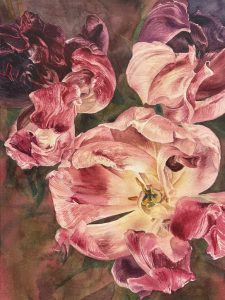
Some of the paintings in this collection feature roses, hydrangeas or tulips in hazy or dramatic light. Upon closer inspection, many of the flowers are wilted or imperfect. Webers said she intentionally focuses on these flowers “past their prime” to draw attention to a less conventional definition of beauty.
“Young 20s or teenage years are the peak of a woman’s beauty [according to society],” Weber said. “I try to capture the beauty when a life is almost ending, like tulips that are shrinking … just before they disappear. That flower [in the painting] is not perfect — it’s already damaged, but I can find the beauty in that.”
According to Weber, an experience with her sister last summer was the inspiration for this collection. Weber said the two used to enjoy art museums together before her sister began losing her vision due to a degenerative eye condition.
“When we were younger, we shared the joy of experiencing art together,” Weber said. “Visiting museums and looking at paintings was something natural between us.”
Weber said she visited an art museum with her sister after five years of living with the condition. In her artist’s statement for the exhibit, Weber describes the experience.
“The galleries were dim, and she [Weber’s sister] could no longer clearly see the artworks,” Weber said. “I walked beside her and described what I saw — the atmosphere, the light and the feeling of the space. She listened and imagined the works through memories of what she had once seen.”
Weber said this experience with her sister made her see light in a new way.
“Watching her experience art through memory rather than sight changed how I understand light,” Weber said. “I realized that light does not disappear when it fades from view. It continues quietly, carried by time, place and remembrance.”