The courtyard in front of the City Hall thudded from loud music as large-scale projectors shot 3D lights onto the building. Downtown Palo Alto bustled with crowds of all ages, excitedly interacting with the street installations.
Code:Art, a biannual free art festival, combines the possibilities of technology with art through interactive media arts for 10 days from Oct. 16 to Oct. 25 in downtown Palo Alto.
The main attraction was the eight-story-tall projection on City Hall from 7 p.m. to 10 p.m., but the event also includes multiple interactive sound and light exhibits scattered throughout each street, including “Grove” by Pneuhaus, “Glow Walk” by Shagun Singh, “Time Stretched Thin” by Joshua Miller and “Screamaton” by Antonin Fourneau and Manuel Braun.
According to Scott Munsen, a fan of the event, Code:Art is attractive because of the wide range of mixed media artwork installed across downtown.
“From 6 to 7 p.m. you’ve got our receptions on Ramona Street with the big video screen and interactive video visuals,” Munson said. “Mac’s Smoke Shop has the ‘Glow Walk’ where you can tap on the big color spheres. Florence Street, in front of the Apple Store, has some crazy fun attractions on that alley, as well as Waverley Street here and these other fun things, so it’s really interactive.”
Cameron Kephart, a member of the technical production team from A3 Visual in San Francisco, said the projection installation onto the City Hall building required careful layering of light with precise machinery.
“We’ve got 435,000 lumen projectors from Panasonic, two channels of light and two projectors per channel for tons of luminosity on the building,” Kephart said. “Once we get the generator set up and all the temporary infrastructure, we plug all the projectors into this bespoke French software media server and we blend all the projectors together. We map them to the architecture of the building and that’s when we turn on the lights, because these artists have all rendered their pieces specific to the architecture of the building.”
According to Kephart, the technicians worked closely with the artists to match their projections with the architecture.
“First things first, we do photogrammetry models, sometimes LIDAR scans of buildings, depending on their complication, so we can give them a picture perfect template of the building that they can create things to,” Kephart said. “That’s how we retain the super tight lines.”
Sophomore Shaurya Thummalapalli, attendee of Code:Art 2025, said the festival caught him by surprise but was intriguing nonetheless.
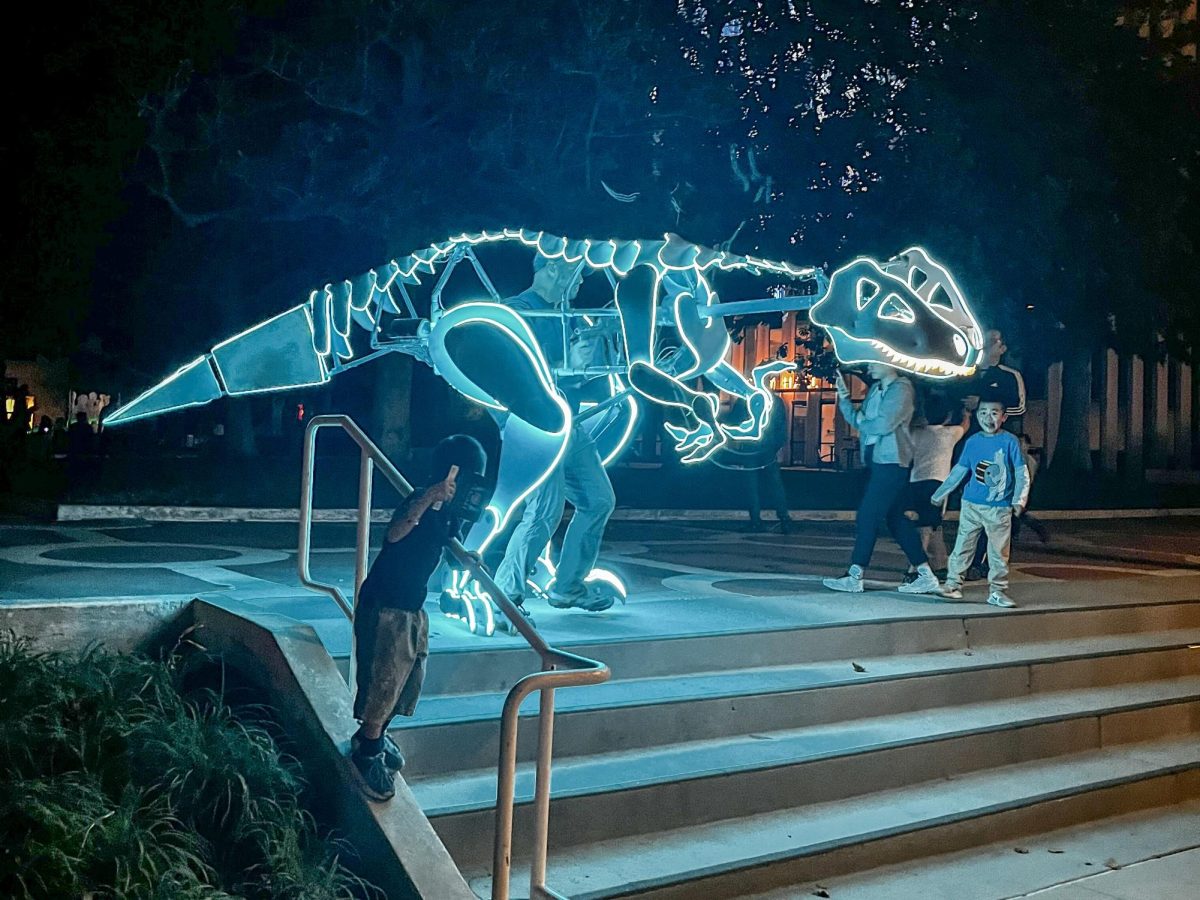
“I actually didn’t know that this was happening,” Thummalapalli said. “Then I saw the dinosaur, and I was really confused. And then I looked to my right, and there was a screaming booth, and then, some port installations. I didn’t really do any research on it, but it was interesting because it was surprising.”
According to Thummalapalli, he would be excited to attend a similar event in the future.
“If I knew there was an art festival, I wouldn’t really expect this,” Thummalapalli said. “It’s definitely interesting. If there was another, I would definitely go to that and see what it’s about.”
Kephart said he loved watching people connect over artwork at festivals like Code:Art.
“My favorite part of these events is seeing community come out, seeing the look of wonder in people’s faces when they see the artwork,” Kephart said. “I myself am not a digital artist, so it’s really cool to have a hand in getting their work at this massive scale on the side of a building, and seeing people come together and enjoy it.”