Allison Ma
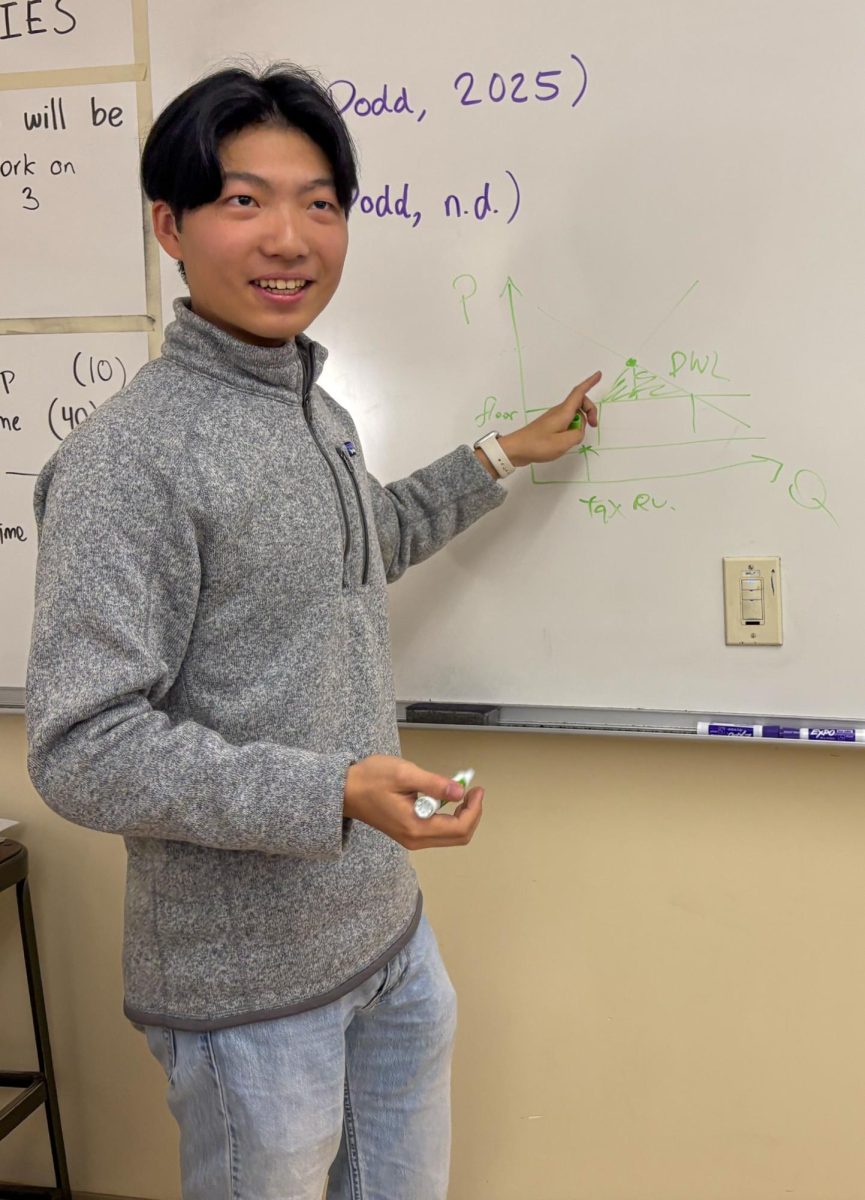
Jerry Yan, Boundarie co-founder and senior, lectures on supply and demand graphs in Paly's Economics Club. According to Yan, Boundarie is available even to low-income students. "It [Boundarie] is completely free for low income or international students who need help," Yan said.
A personal statement, many supplemental essays and an activities list.
These are all requirements that applicants for United States colleges need to supply and a source of stress for many current high school seniors. For international students, the stress is amplified. Navigating a system different from what they know and testing English proficiency adds additional strain on top of what the average U.S. applicant has to do.
Boundarie — a student-led non-profit developed by Palo Alto High School seniors Jerry Yan and Alex Zha, Basis Independent Silicon Valley sophomore Deshan Ma, Leland High School senior Walter Peng and The Harker School senior Robinson Xiang — is a Bay Area student-run innovation that can act as a solution to application difficulties. The program provides free online one-on-one meetings between high school and college students who have already been through the exact same process, and it has been able to help over hundreds of students.
According to Yan, co-founder of Boundarie, the program has reached students from all over the world.
“We’ve had about 300 to 400 students use our platform and in addition to that, it’s very global, like [students from] Africa, South America, Asia,” Yan said. “Our organization’s name is Boundarie Global, since we’re trying to go for a global reach, mostly because of my background and like how I’m trying to direct the mission.”
Yn said that he and his friends founded the company to help students with the complicated college application process.
“We had a couple [of] seniors in a club previously and they were reflecting on their college application experience, and they felt like mentorship is really important,” Yan said. “We connected all those dots together and thought, ‘What if we could get a person who has been there and done it?’ … That was the premise of Boundarie — to break the boundary between international students and students in the United States.”
As an international student, Yan said he is driven to help everyone from anywhere apply to U.S. colleges and universities.
“One of the motivations that I created for this platform was because I lived in China until ninth grade,” Yan said. “I really wish I had a mentor back then too, you know, and navigate the entire process of immigrating and the college application process. I’ve also had a lot of friends in China who are experiencing the same thing.”
Yan said that the Boundarie team created a mentorship system by pairing prospective high school students with current college students.
“Most of the time, it’s the students who pick the mentor,” Yan said. “But, if they outreach to us … if they’re looking for someone specific … we tend to put our entire database and look for a mentor that’s similar in background or is interested in similar things, and then we match them based on that, so that we can form authentic mentorship and relationships between the student and also the mentor.”
According to Yan, students can meet with mentors as often as they want due to the convenience of the system.
“It [Boundarie] is online,” Yan said. “It’s based on how much they want to do. … Sometimes it’s coaching for long-term strategy, or sometimes it’s just trying to understand how the entire process works, like what even Common App is sometimes. All of those things tied together, it’s [the meetings] sometimes once per week, sometimes, five times a week. … Sometimes it’s just once a month or they just only use our platform once.”
Boundarie highlights not only new opportunities for international high school seniors but also the innovation behind student-created passion projects.
Yan said that Boundarie has made an emotional impact on him and his friends because of the results the program has had on others.
“If you have something you’re passionate about, you should try out an initiative or just to direct yourself towards something that could be life-changing for someone else,” Yan said. “When I was making this project, we started out with no customers or users. But once we started seeing the reviews flooding in, some of them caused some of our teammates to shed tears because it is really, really heartwarming to hear about how students were able to get scholarships and come to the U.S. to study.”
As president of the nonprofit, Yan said that he manages all operations and new potential ideas.
“My role is mostly … strategic direction of the entire nonprofit,” Yan said. “So, for example, like outreaching to other nonprofits, looking out for grants, sometimes, and helping my team code the project. … We mostly operate as a friend group, but we still want to maintain some kind of structure so that we can keep moving. We still vote on most things, like whether we should accept this student as a mentor, but I just do most of the strategic things. ”
Boundarie has utilized social media platforms, such as TikTok, as a tool to grow their audience — reaching almost 17,000 followers and 3 million likes.
Yan said the skills he learned from Paly’s Economics Club directly informed how he helped build Boundarie.
“It [Economics Club] helped me understand how to create a sustainable business model and understand issues in the world,” Yan said. “A lot of it is economical, and we discuss that in Econ Club.”