Joy Tan
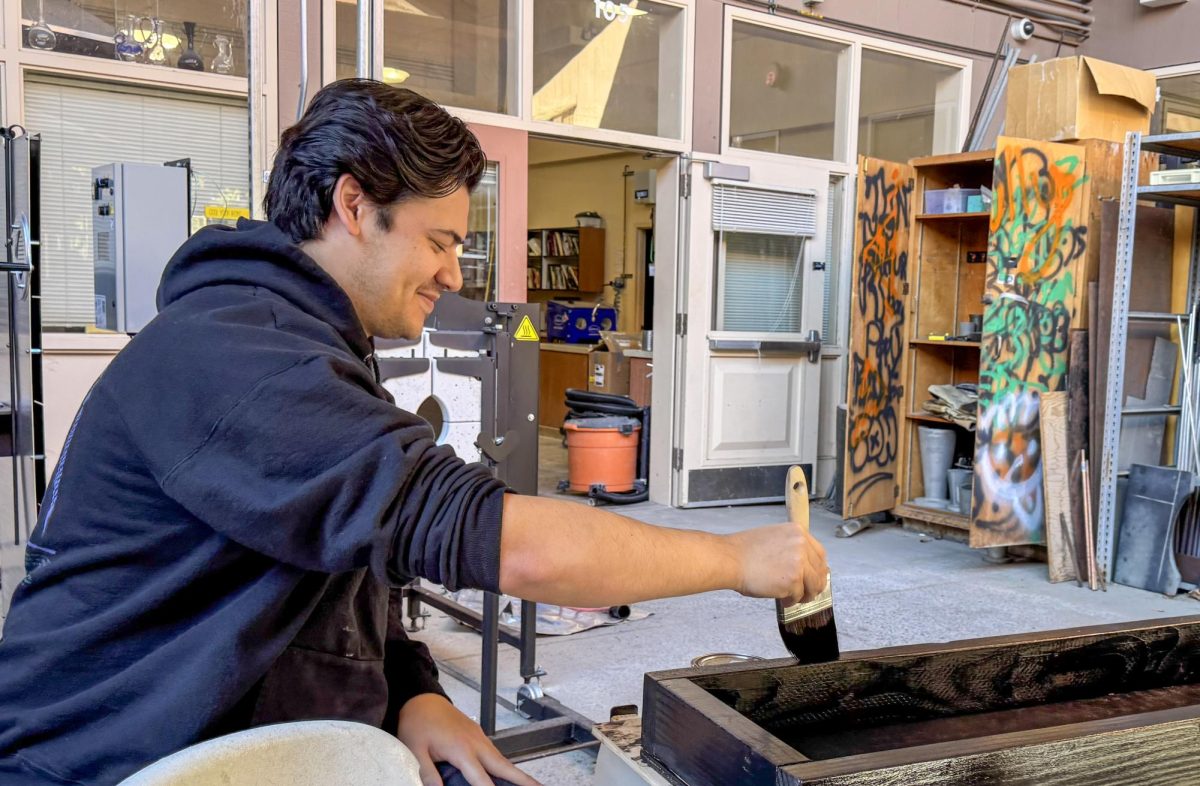
Teaching assistant Andrew Guillet paints a cupboard at Palo Alto High School surrounded by the new glass blowing equipment just before Thanksgiving. According to Guillet, the new equipment not only attracts students but artists outside of Paly. "With the new equipment we also attract visiting artists who want to come work here and teach students," Guillet said.
For years, Palo Alto High School’s glass blowing program existed as a mysterious “phantom” class tucked behind the ceramics room, known only to a handful of students willing to brave the heat. This year, that changes.
With a major studio upgrade, a new Career Technical Education designation and a revamped 3D art pathway, Paly’s glass and ceramics programs are stepping into the spotlight.
Offering students both professional skills and the opportunity to work on a larger scale, Glassblowing teaching assistant Andrew Guillet said students can now also earn CTE credit.
“We recently became a part of the CTE curriculum here at Paly, so the students now in AP and Advanced Ceramics Art are able to get CTE credit and learn about things like studio maintenance and how to run an art business themselves,” Guillet said.
According to Guillet, the new equipment is not just about shinier tools; it’s about what students can actually do with them.
“The new studio equipment is going to help them learn about maintenance and also allow for new artists to come out and show their work at a higher scale,” Guillet said.
According to art teacher Mike da Ponte, the glass program had not been fully integrated into Paly’s official Visual and Performing Arts pathways for years.
“It’s showing Palo Alto High School what is really available,” da Ponte said. “The glass program has always existed as this phantom program — like it existed, but it wasn’t ever really embedded into the program. So, really diving in and also showing my expertise and what’s even possible with this stuff is just a new chapter.”
Part of that new chapter is a restructuring of the course sequence. The pathways have been split into two, with a 2D pathway and a 3D pathway, which allows students to focus more on glass and ceramics projects. Even within the 3D pathway, da Ponte says students still get foundational skills in drawing and design.
“In that pathway we’ll still do some 2D things like learning about color theory and perspective drawing,” da Ponte said, “but everything is incorporated into 3D design.”
Along with the curricular shift came a much-needed equipment overhaul. The previous setup, da Ponte said, was becoming difficult to maintain.
“The old equipment we had was just kind of outdated and run down, so it was time for a change,” da Ponte said.
According to Guillet, there has already been a noticeable change in student interest.
“Now, just in the last couple weeks, when we got this brand new equipment, there are kids who for the past couple of months, maybe weren’t so interested in blowing glass outside. But now that we have the new equipment, it’s safer, more effective and it’ll let them work better,” Guillet said. “They’re more interested now than they were before.”
According to Glassblowing teaching assistant Nahah Alboushi, for many students, glass blowing isn’t something they expect to encounter before college or at all, and it’s amazing that Paly students have the opportunity.
“I think it’s amazing,” Alboushi said. “Not many high schools in the United States have glass blowing facilities and if you get into it and then you go to a college that has glass blowing, you can just start out making the projects that you want to make instead of having to learn all the technical skills.”
By giving students a chance to start early, the program doesn’t just offer an unusual elective; it gives them a head start in a highly specialized art form. That includes understanding how a working studio functions day to day, a crucial piece for students who might one day run their own space or work in a professional shop.
According to da Ponte, the revamped studio is also larger, more complex and more powerful than before and that makes safety and staffing even more important.
“Because it’s a large space, there are a lot of mechanical moving parts,” da Ponte said. “So having an extra set of eyes is more of a safety thing because it’s a lot of things to operate and do for one person, so having more help is awesome.”
The combination of more space, more equipment and more adult supervision opens possibilities for bigger and more ambitious projects. da Ponte says the upgrades mark more than just a facilities improvement — they signal a shift in how Paly treats 3D art.
“This new stuff is going to help us usher in the new program,” da Ponte said. “It’s just a new chapter.”