Joy Tan
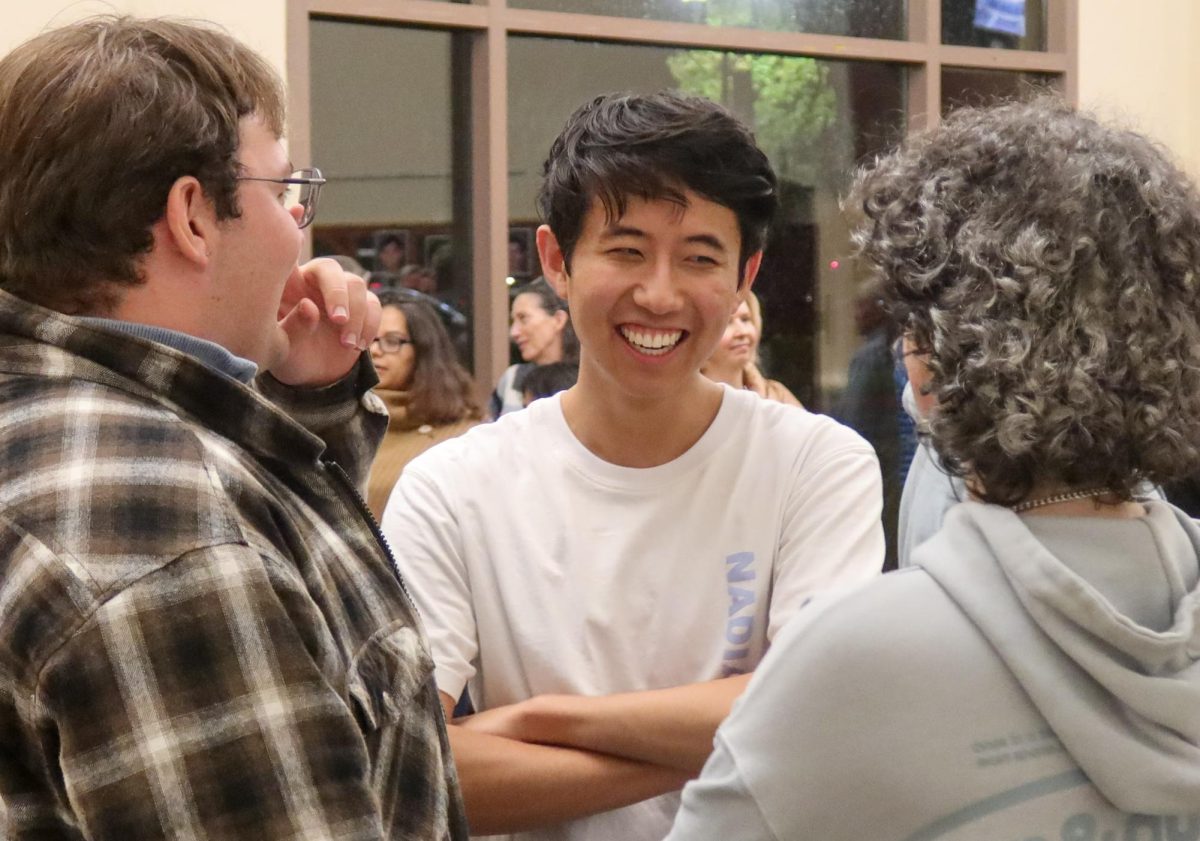
Senior Brendan Giang talks to friends in the in Palo Alto High School's Performance and Arts Center after acting in Paly's theater show the "Crucible" Saturday night. According to Giang, he loves telling stories through multiple mediums. "I really enjoyed telling stories, whether it be acting in plays, making movies or writing," Giang said.
Long before his documentaries reached members of Congress, before city-funded film programs and 30-person crews, Palo Alto High School senior Brenden Giang was a kid making “silly projects” with a camera and a lot of imagination. Giang says one of his earliest attempts was a parody of a Twenty One Pilots song that he filmed, edited and even performed in.
“It [the video] is pretty bad. It’s pretty horrendous,” Giang said. “But it’s kind of funny, and nobody’s ever seen it.”
Those early experiments came from a pure fascination with visual play. Giang spent hours studying YouTuber Zac King’s optical-illusion videos, trying to mimic the magic with his friends. Those playful beginnings grew into something more serious when a Cable-Satellite Public Affairs Network (C-SPAN) documentary assignment in high school revealed an insight that changed him: Stories weren’t just entertainment, they can shape conversations, communities and even policy.
According to Austin Davis, history and Social Justice Pathway teacher, the StudentCam is a competition hosted by the cable television network C-SPAN.
“Each year they [C-SPAN] will put together a prompt for the project,” Davis said. “There was Grand Prize, first prize, second prize, and honorable mention. Brendan’s group got first prize in the Western division.”
Giang’s group was also made up of seniors Emily Tang and Max Reiter, and their award-winning documentary “Threads of Change” is an investigation into fast fashion, climate change, and consumer responsibility. The film didn’t just win first place; it garnered awareness and connected Giang to policymakers around the country.
Giang said the proposed policy idea of more detailed labeling on clothing was inspired by nutrition labels on food.
“Imagine if when you buy an article of clothing, there was a climate label with water consumption, carbon footprint, durability and things like that,” Giang said.
That idea became a bipartisan bill introduced on the floor of Congress in July 2024. Giang worked with Dr. Nikki Roy in Illinois Representative Sean Casten’s office, collaborating with Florida Representative María Salazar to draft the legislation. Even though the bill is stalled, Giang said the experience reaffirmed something important to him.
“I really was excited about that [the policy],” Giang said. “It showed me the power that film has to spark action.”
Social issues remain central to Giang’s work. His next project, an out-of-school award-winning short film “Cake with the Cream,” was directed, written and shot with students from Paly. Released in the summer before senior year, the film explores themes of mental health, eating disorders, body dysmorphia and the pressures of social media.
According to Giang, he sees film not only as a mirror but as a bridge.
“Watching a film is a social activity,” Giang said. “You’re watching someone put their perspective of the world into something you can interact with … and what you take from that is completely up to you.”
According to Giang, documentaries like Al Gore’s “An Inconvenient Truth” shaped his understanding of film’s power.
“The way it [“An Inconvenient Truth”] brought climate change to light on the national and international stage is why I love film because it can incite questions and it can motivate you to take actions on things,” Giang said. “That sort of impact of film, I think, is invaluable,” Giang said.
Giang’s newest project, “Next Door Ahead,” is his most personal work yet. Filmed in September with a cast and crew of over 30 students and professionals, the short film follows Xavier, an 18-year-old who wakes up in “the surreal hallway of his mind.” Each door opens onto a shared memory with his best friend David, and as the story unfolds, viewers learn the truth of what happened and what might happen next.
According to Giang, the film is based on real events from his life and was shot in Palo Alto.
“It’s based off a lot of experiences I’ve had in my life, like suicide,” Giang said. “We shot at Pizza My Heart here in Palo Alto and also in the school [Palo Alto High School] gym hallway downstairs.”
Even as he develops his own films, Giang is determined to support the community. This year, he launched a city-funded Film Lab in partnership with Palo Alto’s Teen Arts Council and The Paly Responsive Inclusive Safe Environment Club. Freshmen and sophomores attend workshops on healthy relationships and consent, and the district wanted a new short film to accompany the curriculum, one that spoke to Palo Alto teens directly. Giang said it was important that the film was made in Palo Alto.
“It’s a Palo Alto story for Palo Alto teens to talk about these sorts of issues, ” Giang said.
According to Davis, who is also the adviser for the RISE Club, the film will focus on more than just romantic relationships.
“We’re not talking just about romantic relationships,” Davis said. “We’re talking about how you can have a healthy relationship with your friends, your parents or with other members of your community”.
According to Giang, through every project — political, personal, or community-based — he circles back to one conviction that storytelling is an act of empathy.
“When we empathize with each other, when we listen to each other, when we take the time to think about each other, that is when the world becomes a better place,” Giang said.
For a filmmaker who started with backyard magic tricks and parody videos, the vision is ambitious. But Giang’s track record already shows what he learned early on. Film is just one way, but Giang said he encourages others to find other ways to connect.
“You can find your own ways to do that, and it doesn’t have to be a film,” Giang said. “But I really encourage you to connect with other people, because on any level, that connection is what keeps our common humanity.”