Philip Shen, The Campanile
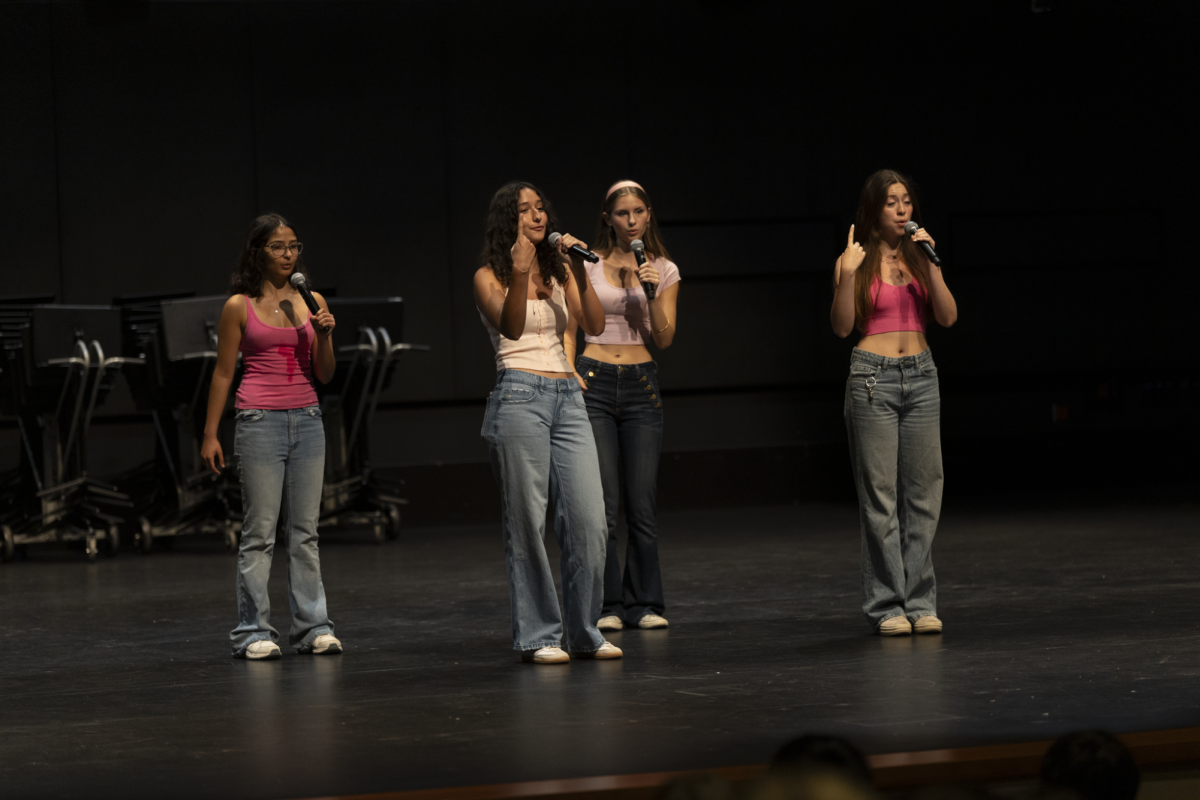
Palo Alto High School's color-coordinated a capella group, The Heartbeats, performs a rendition of a medley from the iconic movie series, Pitch Perfect. They, with three other Paly groups, worked with the movie's arranger — Deke Sharon, on Thursday. Heartbeats senior Simone Batra thought the experience helped her grow musically. "When we worked with Deke, he taught us how to blend so many different aspects of music into one," Batra said.
Stage lights blinding, microphone in hand, anxiously trying to remember the choreography, we sang each chord as precisely as possible to impress the man known as the father of modern a cappella.
Deke Sharon, the arranger-director of the series ‘Pitch Perfect,’ coached Palo Alto High School’s a cappella groups late last month. As the creator of over 2,000 a cappella arrangements, he was able to give expert and professional advice to Paly’s four groups — Heartbeats, Heartbreakers, Folkyes and Vikapella.
After walking offstage, each was a changed group. Depending on what each song needed, Sharon increased energy, shifted vowel tone, taught microphone skills, or even changed rhythm. When he told Folkyes that their background vocals should be in swung time to add a laid-back vibe, their singing immediately came to life. As he taught the Heartbreakers proper microphone technique and had soloists match a brighter tone, each voice shifted from separate and incohesive to blending perfectly together.
What struck me the most after Sharon’s musical talent was his humility. His goal isn’t to produce the best movies or sell the most albums — it’s to make raw, human music into something magical. He has dedicated his entire life to preserving and fostering a cappella as it changes with time, all for the love of the game.
Sharon will continue to work intermittently with Paly’s groups for their Fall Concert on Oct. 26 and upcoming Spring concerts, even personally arranging pieces for them.
Q: I really liked what you’ve said [in the past] about how a cappella has changed over time — it’s been barbershop, it’s been doo-wop, and now it’s contemporary. Can you elaborate a little bit on that?
A: A cappella is the oldest music in the world. Before there were any instruments, before written history, before notation, anything, people sang. … We communicated with tone in our voices before we had anything resembling language. … If you look through history, rich people, poor people, it doesn’t matter. Cultures all the way around the world — a cappella is at the core of their tradition. … There are so many different periods of music that we now go back and look at, and we’re like ‘Oh, wait, that was a cappella also!’ So the idea of people singing current popular music is not new at all; it’s very central to who we are as humans.
Q: That’s very powerful, thank you. So, how did all of the arrangements and the opportunities you had before Pitch Perfect — like [NBC] ‘The Sing Off’ — build up to Pitch Perfect, which is your most well-known arrangement?
A: It’s great that Pitch Perfect had all of that success. I never expected it. Before I graduated, I was getting phone calls from other groups who were like, ‘Oh, can you arrange the way you arrange for my group, as well?’ because I developed vocal percussion, and I developed vocal instrumental sounds, and had a new way of being able to capture a cappella with voices.
Before that, and when I joined a college a cappella group, everybody was singing … these songs that were already very vocal and very a cappella. But nobody was doing Led Zeppelin. Nobody was doing Pink Floyd and Pier Gabriel, and all this music that people can do now. I want to do the music you couldn’t do a cappella. I just wanted to get more and more people singing … so that more people could have a wonderful life.
Q: I love the notion that anything can be a cappella. Can you expand on that?
A: Well, not every group will sing every song well, just as not every restaurant can make every kind of food well. In fact, when I was working on ‘The Sing Off’, with groups like Pentatonix, I always tell them: ‘Don’t copy the song, bring the song to you. Who are you? How can you make your version of the song different from the original?’ And sometimes it is better.
Q: That actually leads right into my next question. When you’re working with singers, do you tend to be flexible with their voices, or do you try to morph their voices to fit the song, or does it depend?
A: In the end, it’s kind of both. Ideally, the arrangement takes the song and brings it to the group, but there are times when a group’s skills need to be pushed a little bit to find a new thing. For instance, when we were doing ‘The Sing Off’ season four, there was a group that came in … and two of the new members of the group had southern drawls, and myself and the casting director were like, ‘Do we think they could be country a cappella?’ They auditioned with a country tune, and we brought them on the show … and they won season four. Now they play at the Grand Ole Opry, have multiple albums, and are the world’s first country a cappella group, ‘Home Free.’
Q: You mentioned the Grand Ole Opry. When I went to Nashville, I just thought it was so powerful how they [the band] sat down, and they were taking crowd gospel requests, and Jamie Johnson he said, ‘it’s [the song] in G, you’ll figure it out!’ and they just all started making music together. Just so powerful.
A: That is the power of the unifying ability of music. And here’s the thing: singing is the most personal kind of music. Everybody has a voice. Everybody is instrumented. Very few people on planet Earth are actually tone deaf; they’re just under-experienced. Imagine you rarely pick up a basketball. How many free throws would you hit? It’s like that. You pick up a basketball more often, you’re not gonna be Steph Curry, but you might be totally workable.
That’s something we’ve lost a lot as a culture. … When you have those moments where you just connect with others, it is so transformative. It is a statement of what we need in society now, to stop vilifying others, but recognize that we need to come together to solve the difficult problems, regardless of our backgrounds and beliefs, and all that stuff. We need more of that unity, and I really do believe that a cappella can help knit back together the fabric of society and heal the world in a way that few other things can.
Q: That’s beautiful. I have one last question: are you working on anything right now?
A: I do have some irons in the fire for movies, television, and potential projects, but after the streaming wars died down, I had a couple of projects that were canceled, like so many others were. … Through the 2010s, a cappella was the flavor of the month for a decade. We had a really good run there. But I don’t expect to have tons of other things to do. I think there might be a ‘Pitch Perfect Four’ one day. Maybe, but I don’t know. And time will tell. Could there be an a cappella musical? Maybe.
But I never needed any of that. That wasn’t the point. That’s just a way of popularizing a cappella, getting more people singing. My job right now is to help all of the musicians around the world, all of the choirs, all the educators, all of the singing groups — pro, amateur, doesn’t matter — to get more of an audience, to get more people to join the group, and to get more and more attention in the media, just doing what they’re doing. Because when people hear a cappella, and they hear singing … it really grabs them the way no other kind of music can, because it’s so human and so honest.