Priya Tamura
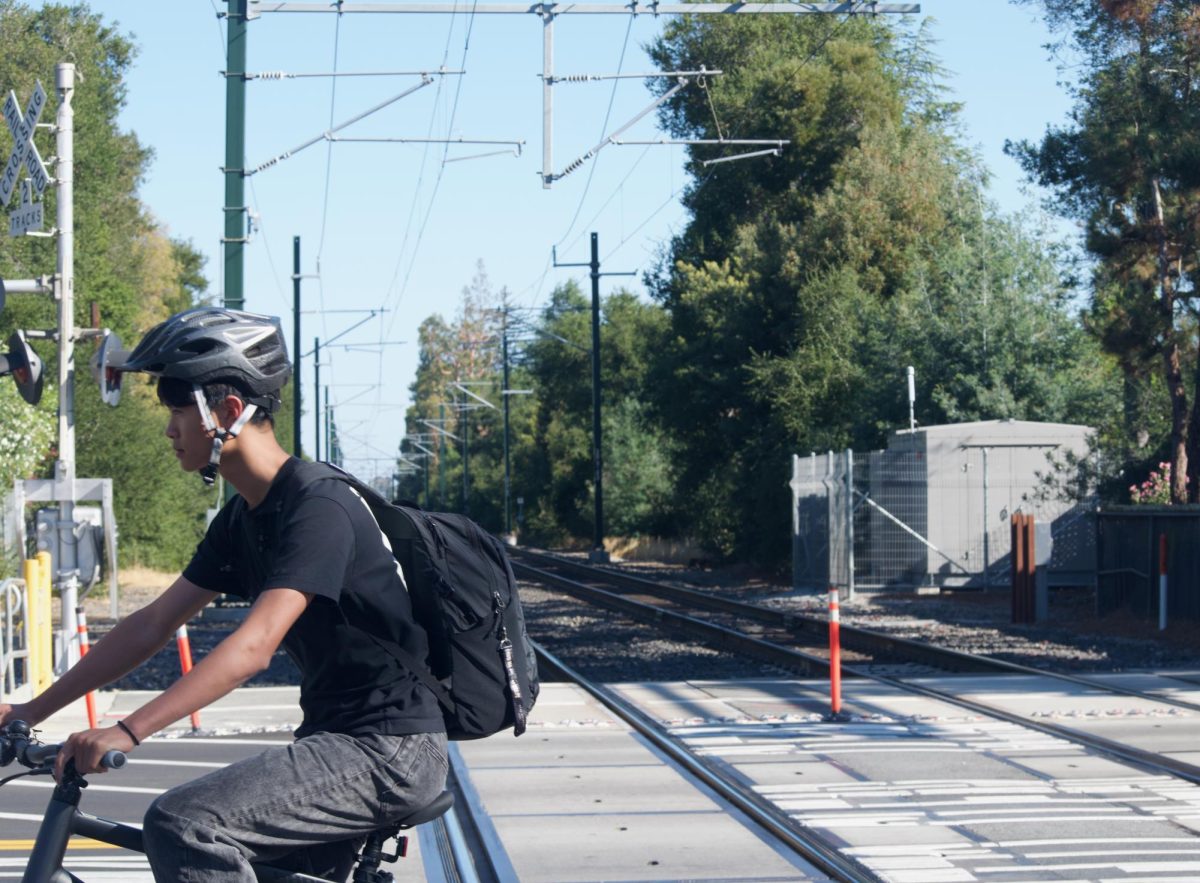
Sophomore Kyvan Chen bikes over the Churchill Avenue crossing at the end of the school day Tuesday. Dan Lieberman, public information officer for Caltrain, said RailSentry was installed at the Churchill Avenue and Alma Street crossing earlier this year. “It is a LiDAR (light detection and ranging) and camera-based AI solution that can identify when people, cars or objects are acting out of the ordinary, allowing Caltrain to alert trains and dispatch the Transit Police,” Lieberman said.
The City of Palo Alto and Caltrain are implementing new train safety measures and evaluating their effectiveness following a recent push for enhanced rail safety.
One of these safety measures is a new artificial intelligence-based technology known as RailSentry. Caltrain installed the new AI technology in March, and it was made operational in April at the Churchill Avenue and Alma Street crossing.
According to Dan Lieberman, public information officer for Caltrain, RailSentry uses both light detection and radar technology (LiDAR) and cameras to detect potentially hazardous behavior surrounding rail crossings.
“After observing hundreds of hours of normal traffic flow, the AI learned what behaviors indicated a pedestrian or car was at risk, allowing RailSentry to quickly identify potential risks and respond by contacting Caltrain’s dispatch center,” Lieberman told The Paly Voice. “Installation went smoothly and RailSentry was operational within a matter of weeks after installation.”
Palo Alto mayor Ed Lauing said RailSentry is used to alert trains of potential collisions if dangerous behavior is detected on the tracks.
“The faster braking electric trains are quickly notified to slow and stop in response to vehicle and pedestrian intrusions at Churchill,” Lauing said.
Don Austin, Palo Alto Unified School District Superintendent, told The Paly Voice during a press availability session on Sept. 11 that RailSentry has not yet been used at the Churchill Avenue and Alma Street crossing, making it too early to assess its effectiveness.
“I don’t know how they measured success, because to my knowledge, it [RailSentry] has not stopped a train yet,” Austin said.
Lauing announced the formation of a special committee at a mayoral community and press briefing in August to address train crossing safety issues.
According to Lauing, council members Greer Stone, Julie Lychott-Haimes and Pat Burke will take part in this committee.
“This safety committee will coordinate efforts already underway by many individual council members and a number of community groups to address this tragic situation in Palo Alto,” Lauing said. “These three council members will focus on coordination and communication of possible actions to be taken, leverage Caltrain and city resources where appropriate, and make recommendations to the full council on any actions requiring a formal vote.”
According to Austin, “lethal means mitigation” — a suicide prevention strategy that involves reducing an at-risk person’s access to lethal means — would be more effective than Caltrain’s new systems in avoiding student deaths on the tracks.
“There’s technology now that if we knew a student was missing or has left in a bad state, we could have an early alert system that would be better than what Caltrain has,” Austin said.
Austin said this mitigation is a necessary step forward due to Palo Alto High School’s access to lethal means, citing the school’s proximity to the railroad.
“There aren’t many high schools that are built about 50 feet from a railroad,” Austin said. “To get to … [school] you have to walk, drive, or ride a bike over rail. That’s really unique.”