Priya Tamura
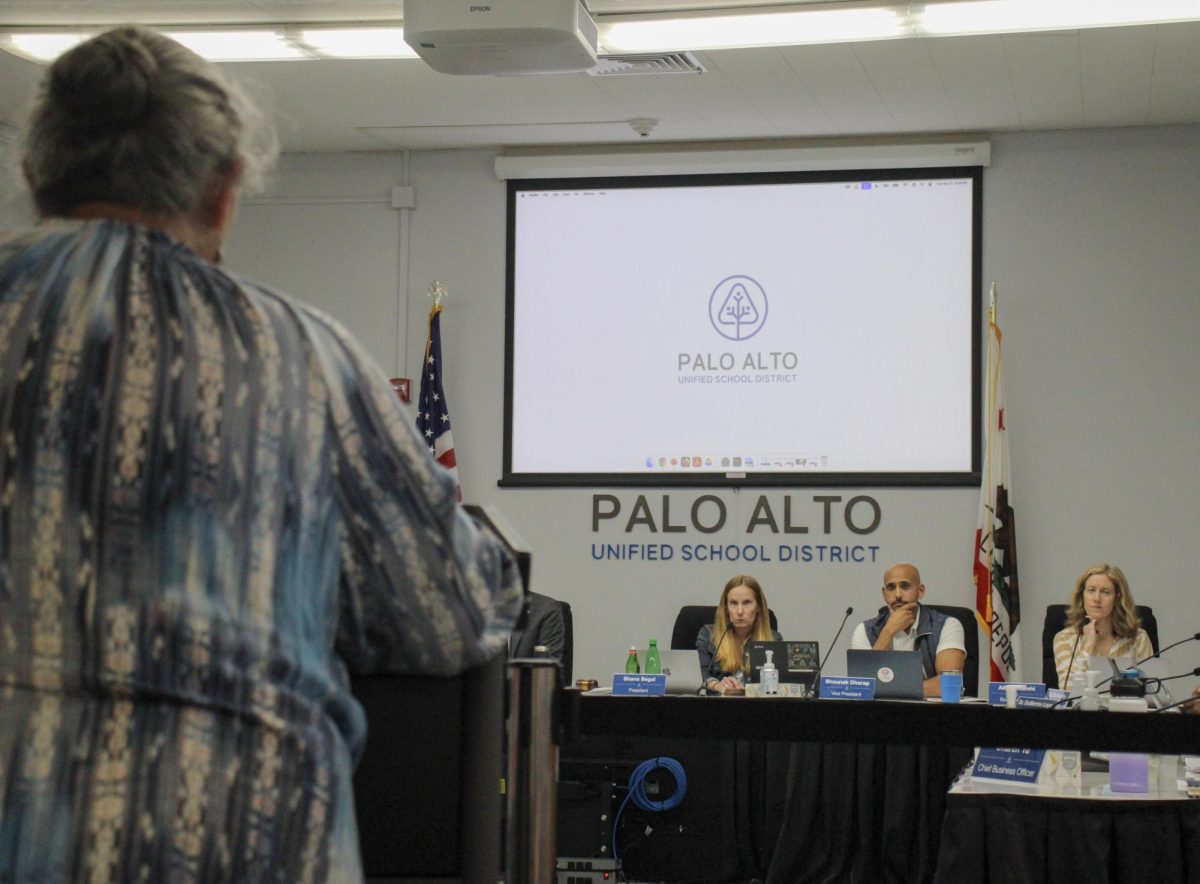
Mrigendra Steiner, California School Employees Association Chapter 301 President, speaks in front of the Palo Alto Board of Education about the importance of investing in paraeducators and classified staff. Steiner said paraeducators play an essential, often overlooked role in classrooms and should be utilized more often. “When you see a partnership between a teacher and a paradigm where they look across the room and they already know, without even saying a word to each other, what needs to happen with a student as we support them in classrooms, is amazing,” Steiner said.
In a push to improve special education and support school staff, Palo Alto Unified School District introduced a teacher residency program and advisory committee at a board meeting Tuesday night.
The district unveiled a $1.8 million Special Education Teacher Residency Program that will allow 40 classified staff members, employees who support schools in non-teaching roles, to earn special education teaching credentials over the next four years, beginning in the 2025-26 school year.
Scott Chappell, chapter secretary for the CSEA Chapter 301, said the district’s support for staff training shows what can happen when every employee is given the chance to feel valued and make a difference.
“Regardless of job title and regardless of the job setting, contributions matter,” Chappell said. “Every staff member, regardless of whether in the classroom, the front office or behind the scenes, we are essential, and all of us deserve opportunities to grow.”
Mary Ann Fogle, a four-year instructional aide at Fairmeadow Elementary School, said her motivations for joining the program were rooted in her passion for special education and the opportunities it grants her.
“I chose this program because in one year I can become a special ed teacher and earn my master’s degree at no additional cost,” Fogle said. “I want to develop meaningful work for students so they feel loved and accepted.”
Italia Rico, a primary language tutor at Addison Elementary, said the residency program gives her a clearer path to becoming a teacher and making a greater impact. Rico said she works with many students who have recently immigrated to the U.S. and often face struggles adjusting.
“Their self-esteem is so low because everything’s changed — the culture, the people, even the faces,” Rico said. “I tell them, ‘I understand you, and you’re not alone. We’re a team.'”
According to Christina Schmidt, she has followed special education issues for many years and said the teacher residency program offers a much-needed solution to both teacher shortages and retention challenges in the field.
“This is it,” Schmidt said. “This is action. Policy in action. And that’s what I love most. That’s what really works, and we see it work, and that’s exciting.”
In addition to the residency program, PAUSD announced the formation of a new Special Education District Advisory Committee.
According to Yolanda Conaway, assistant superintendent of Equity and Student Affairs, the committee was created to serve as a collaborative think tank for the district’s special education programs and will provide input and guidance on improving services across the district.
“We wanted to make sure we didn’t just have the voices of our district office and site personnel, but really engage the community, our teachers, and our board members,” Conaway said.
However, not all community members are confident in the committee’s structure. PAUSD parent Jane H., whose last name was not provided, said she was concerned about the committee’s transparency and lack of parent voices from secondary education levels.
“[The committee] is comprised of twice as many staff as parents,” H. said. “Parents who were selected … were primarily parents of lower elementary students who don’t have a lot of experience, and they’re not parents of high school or post-secondary students, which doesn’t include the three individuals who are invited to be on the committee.”
In response to this concern, Conaway said the committee’s structure is still evolving and open to improvements.
“One of the things the committee has already requested was to consider having a student on that particular committee who is a student with a disability,” Conaway said. “It’s important for us to … make sure that we are as diverse as we possibly can be, and ensure that there’s a stakeholder voice represented at many levels.”
School board member Josh Salcman, who serves on the SEDAC, said he was encouraged by the energy and collaboration he saw at the group’s first meeting.
“It was exciting to see the different groups of participants split up into their five different groups and brainstorm the ideas that they had about how we could strengthen the support we’re providing to our students,” Salcman said. “You could just feel the enthusiasm in the room.”
While many praised the district’s new efforts, some speakers also urged faster action.
According to Steven Davis, founder of the Disability Almanac — a group advocating for learning-impaired students —, as the performance gaps between special education students and general education students continue to grow, there must be palpable steps to implement effective supports.
“Do not wait, no excuses, no delays,” Davis said. “Concrete action matters from you, not PowerPoints or meetings or committees. What matters is the outcome for kids, and that’s how to start today. Everything is just fuel for that.”
Balancing that perspective, Salcman emphasized the need to sustain collaboration through the summer.
“One of the things that I left feeling was how important it is that we maintain our momentum,” Salcman said. “There were a lot of people in that room who were ready to keep working over the summer… It’s amazing to feel all of those people together who really want what’s best for our students.”