Priya Tamura
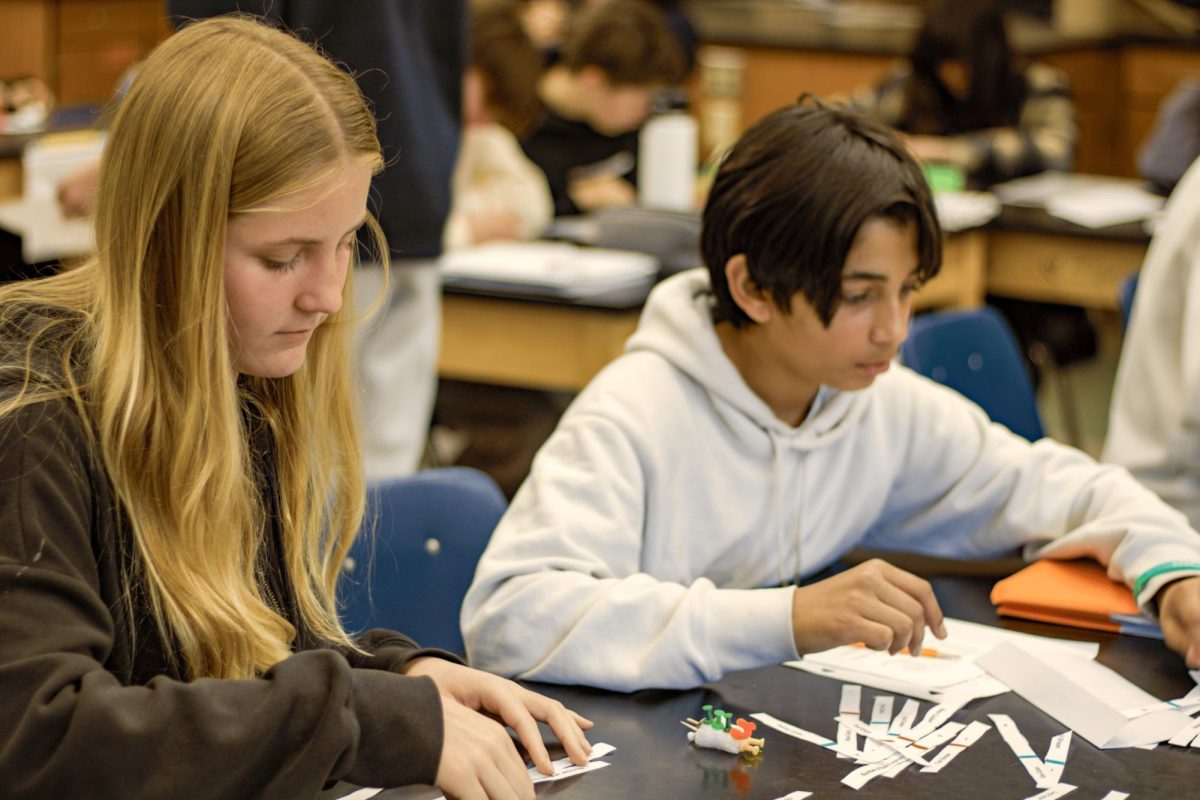
Celeste Nicole and Anay Joshi engage in genetics activities in biology class, building their foundational skills for future science courses. According to Chemistry Honors teacher Nicole Loomis, the planned merging of biology and biology honors next year may create challenges for teachers. “Because Bio is a class that everyone has to take to graduate, the range of student skills in the class is very wide,” Loomis said. “Breaking it into honors and regular lanes makes it much more feasible for teachers to gear their class toward the students either on the higher end or the lower end of those skills."
Is a combined biology class truly best for student learning at Palo Alto High School?
Starting next school year, Paly freshmen will no longer have the option to take Biology Honors. Instead, students will be placed in a single-lane biology class — a change aimed at ensuring equitable access to quality education while maintaining clear pathways to advanced science courses for all.
(More information about the merge can be found in our article here.)
Many students and parents have doubts about the new course’s rigor and effectiveness. At first, we shared this concern; we worried that one lane would not be able to provide the nuance necessary to accommodate the wide stretch of student needs.
For example, We worried that some students would seek a more challenging curriculum to prepare for future advanced science courses, while others might prefer a slower-paced biology course that gives students ample aid if needed.
After speaking with multiple teachers at Paly, we are reassured that merging biology will still provide students with foundational biology knowledge and will not be a barrier to honors-level coursework.
Many students and parents had worries that delaning would disadvantage certain students looking to maximize their honors credits in preparation for college applications. However, according to an email exchange between The Paly Voice and Biology teacher Elizabeth Brimhall, this change will not impact college admissions in any way.
“With only one level of biology offered, universities will see this as a student taking the highest level of intro bio course offered,” Brimhall said. “In addition, since Bio H currently does not get the honors GPA bump that other advanced courses taken in grades 10-12 get, there will be no impact on student GPAs.”
While it’s reassuring that the change won’t affect college admissions, questions remain about whether the new course will adequately prepare students for more advanced science classes.
According to Chemistry Honors teacher Nicole Loomis, the planned merging of biology and biology honors next year may create challenges for students moving on to chemistry honors to learn as effectively.
“It will be a challenge to adequately prepare students for chem honors in an undifferentiated class,” Loomis said.
However, according to Chemistry Honors teacher Samuel Howles-Banerji, a supporter of single-laning, the change will benefit students mentally and socially.
“For many students, there is the mentality that if you’re not taking every honors and AP course available, it will limit your future opportunities,” Howles-Banerji said. “There’s often a thought that those who aren’t taking the honors course are less motivated or less skilled, which creates a sense of ‘us’ and ‘them.’”
Beyond academic pathways, some believe this shift will also help students adjust to the demands of high school coursework. Freshman Emma Haloski, who is taking TEAM biology honors this year, said that merging biology would make the transition from middle school to high school easier for students.
“It’s just a tough transition to high school,” Haloski said. “Besides, the content [in her biology class] is exactly the same, so there’s not much of a change.”
Biology is not the first attempt to remove course laning at Paly. In 2014, a push was made to eliminate English 9 and require all freshmen to take the preexisting English 9 Accelerated (English 9A).
At the time, English teacher Kindel Launer said teachers would differentiate within the same classroom by tailoring assignments and discussions to student needs. A decade later, Launer said that approach is still working.
“Teachers are capable of meeting the needs of learners in their classroom,” Launer said. “Our data shows that 93% of students last year and 92% the year before, of freshmen who signed up for English 9A passed with good grades.”
According to Launer, the success of differentiation in English 9A shows that a consolidated classroom can foster a sense of achievement and belonging for the entire class
“When all learners are in the same classroom, it sends a message to all students that they are capable of rigorous, high-level thinking,” Launer said.
While Launer is confident in the success of differentiation in English, it’s still unclear whether the same approach will be as effective in science, a subject where concepts build quickly and gaps in understanding can grow fast. In this environment, teachers will need to find ways to stretch advanced students without leaving others behind.
To address concerns about varied learning needs, Brimhall said having a combined classroom would also be a great opportunity for peer teaching, which benefits all students’ understanding.
“Students who understand the material could help explain concepts in a different way than how their teachers did to classmates,” Brimhall said. “Education research studies have repeatedly shown that this benefits both the student teaching the concept … and the student being helped.”
According to a presentation given by Brimhall and Biology teacher Joshua Little during the Jan. 25 school board meeting, data will be collected from the next school year as feedback for future adjustments to the new biology course.
Howles-Banerji said that because Biology Honors isn’t a prerequisite for Chemistry Honors, there was no reason why students would be less prepared for the class.
“At present, students who want to move up to the honors lane during their sophomore year may feel unable to do so,” Howles-Banerji said. “This change will make it so that all students have a common experience as freshmen, and can then make a choice as they enter sophomore year what level of challenge they want in their science class, and enter on a level playing field.”
If successful, a single-lane biology class could encourage more students to pursue advanced science, fostering a culture where they feel capable rather than categorized. However, without effective differentiation, students at both ends of the spectrum risk being underserved.
Teachers have dedicated significant time and effort to this transition, striving to balance equity with academic rigor. While concerns from students and parents remain, we are cautiously optimistic, and we hope to see results that reflect strong student comprehension and an increased transition to higher-level science courses.
Now, it’s up to teachers and administration to turn this shift into an opportunity, not a setback. The outcome is unwritten, and the stakes are high. The Paly community, ourselves included, will be watching — and hoping — to see it succeed.